Bills of Quantities for Civil Engineering: A Complete Guide to CESMM4, NRM2, SMM7 and MMHW
A Bill of Quantities (BoQ) for civil engineering is a structured, itemised list of every measured item of work in a project (excavation, concrete, reinforcement, pipework, drainage, pavements), each described and quantified under a recognised method of measurement so that contractors can price the same scope on the same basis. In UK civils the method is almost always one of four: CESMM4 for pure civil engineering, NRM2 for building and developer-led infrastructure, MMHW for highway works, and SMM7 where legacy contracts still demand it. This guide explains what each is, when it applies, and how to prepare a civil BoQ that holds up when a Tier 1 commercial team queries every line.
What a Bill of Quantities actually is (and why civils is different)
A BoQ does three jobs. It defines scope, so every tenderer prices the same works. It enables fair comparison of bids, because the quantities are common and only the rates differ. And it becomes the basis for valuing the work as it is built: interim payments, variations, and final account all reference the bill.
Civil engineering BoQs differ from building BoQs in what they measure and how. Building work is dominated by elements you can largely measure off a drawing as finished components: walls, floors, finishes. Civil work is dominated by ground and bulk operations whose quantities depend on assumptions you have to declare: how you batter an excavation, how much you over-dig for working space, what you can re-use on site versus cart away, how the reinforcement is scheduled. Two estimators measuring the same manhole can produce different quantities, both defensible, because the measurement rules and the stated assumptions drive the numbers as much as the geometry does.
That is why the method of measurement matters so much in civils. It is the shared rulebook that says how each item is measured, what is deemed included in a rate, and how the work is classified and described. Get the method wrong and your bill is not comparable to anyone else's, and it will not survive scrutiny at valuation.
The four standards at a glance
| Standard | Full name | Owner | Best fit |
|---|---|---|---|
| CESMM4 | Civil Engineering Standard Method of Measurement, 4th edition | Institution of Civil Engineers (Thomas Telford) | Pure civil engineering works: earthworks, drainage, structures, pipework; ICE/NEC-style contracts |
| NRM2 | RICS New Rules of Measurement 2: Detailed Measurement for Building Works | RICS | Building work and developer-led / mixed schemes; superseded SMM7 in 2013 |
| SMM7 | Standard Method of Measurement, 7th edition | RICS (historic) | Legacy building contracts and frameworks that still reference it |
| MMHW | Method of Measurement for Highway Works (MCHW Volume 4) | National Highways (Crown copyright, OGL) | Highway and major road works; paired with the Specification for Highway Works |
The rest of this guide takes each in turn, then shows how to choose.
CESMM4: the civils default
CESMM4 is the standard most civil engineers mean when they say "the BoQ". It classifies all work into 26 work classes, labelled A to Z. For example: Class E (Earthworks), Class F (In situ concrete), Class G (Concrete ancillaries), Class I–L (Pipework, in four parts), Class K (manholes and pipework ancillaries), Class R (Roads and pavings), Class P–Q (Piling). Each class has its own measurement rules and a structured way of building an item description from a fixed set of descriptive features.
The defining feature of CESMM is the Coding and item description system: every item is built from a three-division descriptive structure within its class, which makes bills consistent and machine-friendly. CESMM also separates method-related charges, the cost of how you do the work (set-up, plant, temporary works), from the measured quantities, which is a more honest reflection of how civils actually costs out than a flat rate-per-unit.
Use CESMM4 when the works are genuinely civil engineering and the contract sits in the ICE / NEC family. It is the natural home for drainage, earthworks, structures and pipework.
NRM2: building-first, used on mixed schemes
NRM2 is the RICS standard for detailed measurement of building works. It came into effect in 2013 and superseded SMM7. It is structured around numbered work sections and is the right tool for building-led projects.
Be honest about the civils nuance: NRM2 is a building measurement standard. On a pure civils job, such as a highways scheme or a drainage framework, CESMM4 or MMHW fits the work better. NRM2 earns its place on developer-led infrastructure and mixed schemes, such as a residential development with roads, drainage and external works alongside the buildings, where the wider project is being measured to NRM2 and it is sensible to keep the civils elements on the same basis. Knowing when NRM2 is the right call, and when you are forcing building rules onto civil work, is part of being a good civils estimator.
SMM7: superseded, not extinct
SMM7 was the building industry's measurement standard until NRM2 replaced it in 2013. You would not start a new project on SMM7 today. But it has not vanished: legacy contracts, some water-sector frameworks, and certain long-running public-sector procurement still reference it, and you occasionally meet a live project whose documents quote SMM7 rules. The practical skill is recognising when a contract is still on SMM7 and being able to measure to it rather than quietly substituting NRM2, because the rules differ and the difference can move money.
MMHW: the highways standard
The Method of Measurement for Highway Works is Volume 4 of the Manual of Contract Documents for Highway Works (MCHW). It is the measurement basis for National Highways works and most major road schemes, and it works hand-in-glove with the Specification for Highway Works (SHW), with its famous "Series" numbering: Series 600 (Earthworks), Series 500 (Drainage and Service Ducts), Series 1700 (Structural Concrete), Series 1100 (Kerbs, Footways and Paved Areas), and so on. Items are measured to MMHW and described by reference to the relevant SHW clause.
MMHW is Crown copyright, published under the Open Government Licence, which is one reason it is the cleanest of the four to work with openly, and why it is the standard available on the CivilQuants free tier (more on that below). The full Manual of Contract Documents for Highway Works is published online by National Highways.
How to choose the right standard
A short decision guide:
- Is it a road scheme for National Highways or a major highways framework? → MMHW.
- Is it pure civil engineering (drainage, earthworks, structures, pipework) on an ICE/NEC contract? → CESMM4.
- Is it a building or a developer-led / mixed scheme already being measured to building rules? → NRM2, keeping the civils elements consistent with the rest of the project.
- Do the contract documents explicitly reference SMM7? → SMM7, even though it is superseded: measure to what the contract says.
The trap is standards drift: a freelance QS or a small team carries one job's habits into the next, and a highways item gets measured to CESMM4 rules, or a developer scheme to MMHW. Each method deems different things included in a rate and describes items differently; mixing them quietly produces a bill that is not comparable and will be queried. If you work across job types, the discipline is to consciously pick the standard per project and measure to it consistently.
A worked example: a manhole, measured to MMHW
Theory is cheap. Here is a real Bill of Quantities for a single drainage chamber, a 1500 mm internal-diameter precast concrete manhole, 3.5 m deep to invert, measured to MMHW. This is genuine engine output, abridged to the principal rows. You can reproduce it yourself on the free tier with the manhole calculator:
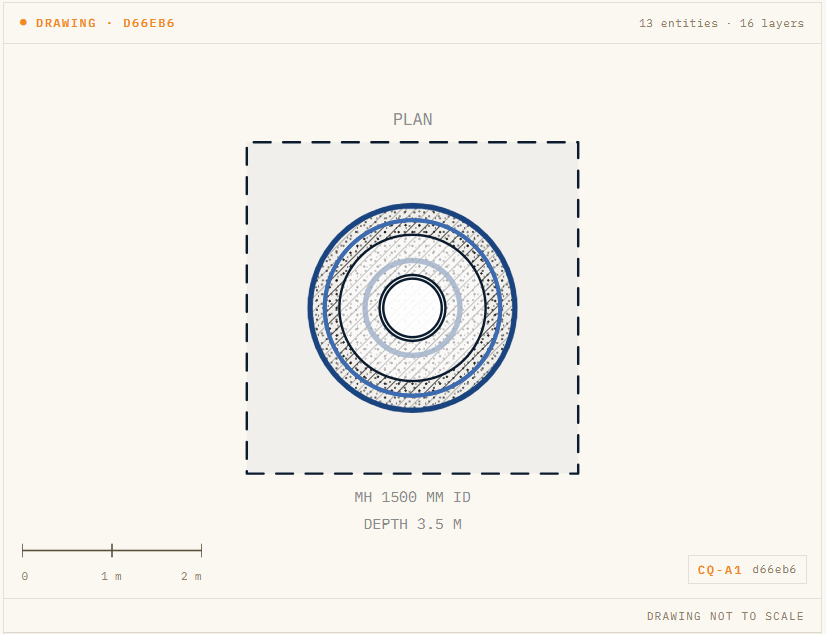
The same chamber in CivilQuants: the generated plan-view drawing, annotated with its internal diameter and depth. The hash cell (d66eb6) is the single reference tying this drawing to its bill, and the same compute exports to DXF, SVG and PDF.
| SHW ref | Description | Quantity | Unit |
|---|---|---|---|
| 2704 | Prime Cost item: Frame & cover, D400, 600 mm clear opening, 150 mm adjustment rings | 1 | sum |
| 600.6 | Excavation for structural foundations (SHW Cl. 607) | 105.54 | m³ |
| 600.5 | Disposal of unacceptable material off-site (SHW Cl. 605) | 7.36 | m³ |
| 600.8 | Site-won acceptable fill, Class 1/2 (SHW Cl. 608) | 98.18 | m³ |
| 600.7 | Imported acceptable fill, Class 6N (SHW Table 6/1) | 0.61 | m³ |
| 1700.1 | Plain blinding concrete, C8/10 (SHW Cl. 1701) | 0.26 | m³ |
| 1700.4 | Reinforced in-situ concrete, C32/40, base slab (SHW Cl. 1704) | 0.69 | m³ |
| 1700.4 | Reinforced in-situ concrete, C32/40, reducing slab (675 mm opening) | 0.49 | m³ |
| 1700.4 | Reinforced in-situ concrete, C32/40, cover slab | 0.09 | m³ |
| 1700.4 | Reinforced in-situ concrete, C32/40, benching | 0.27 | m³ |
| 1700.7 | Steel reinforcement, B500B, 16 mm, BS 8666:2020 | 0.0097 | t |
| 500.3 | Granular surround (SHW Cl. 503) | 3.22 | m³ |
| 500.5.3 | Precast concrete chamber, 1500 mm i.d., depth 3.5 m, incl. base + cover slab (SHW Cl. 507) | 1 | nr |
| 500.6.2 | Galvanised step irons, 300 mm centres (SHW Cl. 509) | 10 | nr |
| 500.6.3 | Pre-formed channel to invert, 300 mm dia. (SHW Cl. 509) | 1 | nr |
| 500.20 | Filter geotextile (SHW Cl. 513) | 25.40 | m² |
Two things worth noticing. First, a single "manhole" is not one BoQ line. It is sixteen-plus measured items across earthworks, concrete, reinforcement, drainage and a Prime Cost frame-and-cover, each measured to its own SHW clause. Second, the quantities depend on declared assumptions: this bill assumed an open-battered excavation at 0.5 (h:v), 0.5 m working space each side, a reducing slab at 1.2 m depth, a D400 cover, and rebar densities per element. Change the excavation support to sheet piling and the excavation and disposal quantities move. A bill that does not state those assumptions is a bill nobody can check.
The same chamber under three standards
Here is the single most useful thing to see on this page: the same physical manhole measured to MMHW, CESMM4 and NRM2. The geometry has not changed, so the quantities have not changed: 105.54 m³ of excavation is 105.54 m³ of excavation whichever rulebook you open. What changes is the classification and the code: each standard files the same work under a different reference and describes it in its own language.
| Item | Qty | Unit | MMHW (SHW) | CESMM4 | NRM2 |
|---|---|---|---|---|---|
| Prime Cost: frame & cover, D400, 600 mm | 1 | sum | 2704 | A.4.1 | 1.7.1 |
| Excavation for structural foundations | 105.54 | m³ | 600.6 | E.4.3.5 | 5.7.1 |
| Disposal of unacceptable material off-site | 7.36 | m³ | 600.5 | E.5.3 | 5.9.1 |
| Site-won acceptable fill, Class 1/2 | 98.18 | m³ | 600.8 | E.6.2.1 | 5.11.1 |
| Imported acceptable fill, Class 6N | 0.61 | m³ | 600.7 | E.6.3.2 | 5.11.2 |
| Plain blinding concrete, C8/10 | 0.26 | m³ | 1700.1 | F.1.1.1 | 11.1.1 |
| Reinforced in-situ concrete C32/40, base slab | 0.69 | m³ | 1700.4 | F.6.2.3 | 11.3.1 |
| Reinforced in-situ concrete C32/40, reducing slab | 0.49 | m³ | 1700.4 | F.6.2.3 | 11.3.1 |
| Reinforced in-situ concrete C32/40, cover slab | 0.09 | m³ | 1700.4 | F.6.2.3 | 11.3.1 |
| Reinforced in-situ concrete C32/40, benching | 0.27 | m³ | 1700.4 | F.6.2.3 | 11.3.1 |
| Steel reinforcement B500B, 16 mm (cover slab) | 0.0097 | t | 1700.7 | G.5.1.5 / G.5.2.5 | 11.15.1 |
| Granular surround | 3.22 | m³ | 500.3 | L.5.2 | 33.2.2 |
| Precast concrete chamber, 1500 mm i.d., 3.5 m | 1 | nr | 500.5.3 | K.1.1.3 | 33.7.1 |
| Galvanised step irons, 300 mm centres | 10 | nr | 500.6.2 | K.8.1 | 33.7.3 |
| Pre-formed channel to invert, 300 mm | 1 | nr | 500.6.3 | K.5.1 | 33.7.4 |
| Geotextile filter, 200 g/m², incl. laps | 25.40 | m² | 500.20 | E.7.2 | 5.12.1 |
Read across any row and the lesson lands: same quantity, same physical work, three different codes. MMHW points each item at an SHW clause; CESMM4 builds a Class letter plus its three-division descriptive code; NRM2 uses its numbered work-section structure. A QS who measures the chamber to MMHW and then needs the CESMM4 bill is not re-measuring. They are re-classifying.
Two differences are worth a closer look. The chamber's 16 mm cover-slab reinforcement is one line in MMHW and NRM2 but two lines in CESMM4: Class G splits it into straight bars (G.5.1.5) and bent bars (G.5.2.5), which sum to the same 0.0097 t. That is a genuine standard difference, not a rounding artefact: CESMM's Class G distinguishes bar shape where the others do not. And the concrete is the strongest illustration of all: the blinding plus the four reinforced pours total 1.80 m³ of concrete, identical across all three standards. It is the same physical concrete in the ground; only the code against it changes.
That is the whole point of getting the method right. The geometry decides the quantity. The standard decides the code, the description, and what is deemed included in the rate.
Why "showing your working" wins more work
Increasingly in UK civils, Tier 1 commercial teams query individual BoQ lines, and frameworks expect an auditable derivation, not just a number. A bill that buries its maths inside Excel cell formulas that no one else can read is a liability at valuation, and a freelance QS personally takes the heat when a line is challenged.
A defensible BoQ shows, for every measured item, where the quantity came from: the dimensions, the rule applied, the assumptions made. That is what lets you defend a rate, win a query, and get paid without an argument. It is also what turns a one-off tender into repeat work: commercial managers remember the estimator whose bills they never have to fight.
Where CivilQuants fits
CivilQuants is a parametric BoQ engine for civil works. You give it the geometry of an assembly (a manhole's diameter and depth, a retaining wall's heights, a length of kerb) and it returns the measured Bill of Quantities, coded to your chosen standard, with the full derivation behind every row. The manhole bill above was produced this way, in one call.
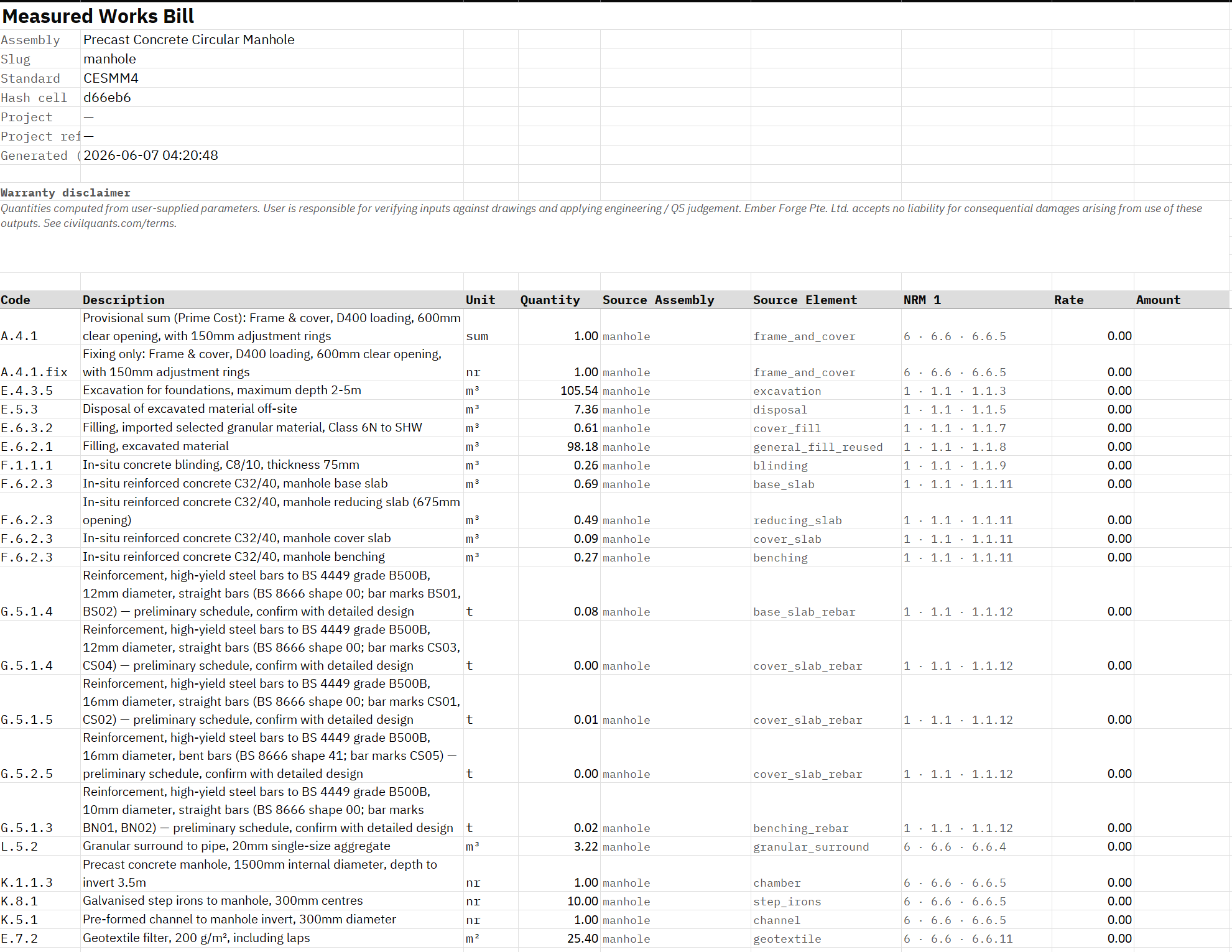
The same manhole's Measured Works Bill, here coded to CESMM4. Every row carries its source assembly and source element, so the quantity can be traced back and defended, and the document-layer disclaimer travels with the output.
- Four standards, one tool. CESMM4, NRM2, SMM7 and MMHW from the same geometry. No four separate template libraries to maintain.
- The working is shown. Every row carries its derivation and the assumptions used, so the bill defends itself when it is queried.
- 46 parametric assemblies across six families: earthworks, drainage, structures, pavements, walls and highway items.
- A free tier you can try on a live job. Six assemblies, measured to MMHW, with the on-screen drawing and a watermarked Excel that includes the audit trail, with no sign-up. The 7-day pass (£15) unlocks all 46 assemblies, all four standards, and clean Excel / DXF / PDF deliverables.
Free-tier output is for research and illustration and is not warranted for tender or contract use.
Try it on a live job. Measure a manhole, a headwall or a length of kerb free, to MMHW, with no sign-up, then start a 7-day pass (£15) when you need all four standards and clean deliverables.
Frequently asked questions
- What is a Bill of Quantities in civil engineering?
- An itemised, measured list of every item of work in a civil project — excavation, concrete, reinforcement, drainage, pavements and so on — each described and quantified under a recognised method of measurement (CESMM4, NRM2, SMM7 or MMHW) so contractors can price the same scope on the same basis.
- Which measurement standard should I use for civil works?
- CESMM4 for pure civil engineering on ICE/NEC contracts; MMHW for National Highways / major road schemes; NRM2 for building and developer-led mixed schemes; SMM7 only where a legacy contract explicitly references it.
- Is CESMM4 still current?
- Yes. CESMM4 is the current edition of the Civil Engineering Standard Method of Measurement and remains the default for pure civil engineering works in the UK.
- Did NRM2 replace CESMM?
- No. NRM2 replaced SMM7 (a building standard) in 2013. CESMM remains the civil engineering standard. NRM2 is used on building and mixed schemes, not as a replacement for CESMM on pure civils.
- What is the difference between MMHW and CESMM4?
- MMHW is the highways measurement method, tied to the Specification for Highway Works and used on National Highways schemes; CESMM4 is the general civil engineering method used on ICE/NEC contracts. They classify and describe the same physical work differently, so a highways item should be measured to MMHW, not CESMM4.
- How accurate are parametric BoQ quantities?
- Parametric quantities are only as good as the geometry and assumptions you give them, and they are intended for estimating and tendering, not as a substitute for detailed design. A good engine makes its assumptions explicit so you can check and adjust them. CivilQuants free-tier output is for research and illustration and is not warranted for tender or contract use.
- Can I produce a civil BoQ without expensive software?
- Yes — many estimators work in Excel. The cost is time and consistency: you rebuild the same take-offs each tender and the working is hard for others to follow. A parametric engine like CivilQuants gives you the measured bill and the derivation in one step, with a free tier to try before you commit.