Box and Pipe Culverts: How to Bill Them in a Civil Engineering BoQ
A culvert is never just the barrel. To bill one properly you measure six things: the excavation, the bedding and surround, the barrel itself (precast box units or a pipe run), the end structures (headwalls and wing walls), the scour protection at each outfall, and the backfill. Get the barrel and forget the end structures and you have under-measured the job by a structure at each end. The clean way to think about it is to split the culvert into the barrel and the two ends, measure each, and let the standard band the work by size and depth. This post walks a precast box culvert with quantities you can reproduce.
For the wider document see a civil engineering Bill of Quantities; for the end-structure detail, see how headwalls and wing walls are measured.
The components of a culvert bill
Whatever the barrel type, the same component list applies:
- Excavation. A culvert is a structural foundation, so the dig is measured to the structures excavation rules, not the trench rules. Working space and batter drive the volume.
- Bedding and blinding. A levelling layer of blinding concrete under the barrel, and a separate bed under each headwall.
- The barrel. Either precast box units (enumerated, by size band) or a pipe run (linear, by bore and depth band).
- End structures. A headwall at each end, often with wing walls, set on their own bedding. These are real units with their own quantities, and they are where most culvert bills leak.
- Scour protection. A rock-armour, gabion or concrete apron at the outfall to stop the discharge eroding the receiving channel.
- Surround and backfill. Selected granular surround to the barrel, then general fill over the top to formation, with a geotextile separator where the surround meets native ground.
Box culvert: worked example
The example below is a precast concrete box culvert at the calculator default: 1500 mm clear span by 1200 mm clear height, 12 m long, with the invert 2.5 m below ground. It carries a precast headwall at each end with rock-armour scour aprons. The quantities are real CivilQuants engine output, measured to MMHW (the Method of Measurement for Highway Works), and generated for this article. Treat them as a modelled example for illustration, not a tender; every number is reproducible from the same geometry.
The point of the box assembly is that it composes the whole culvert in one pass: one set of inputs returns the barrel, both end structures, and everything around them.
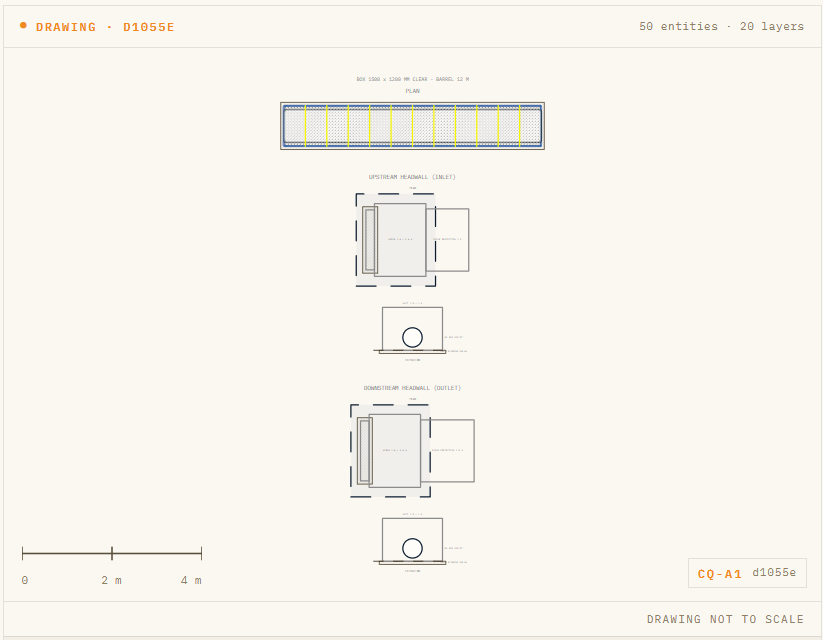
The culvert sheet (hash d1055e): the precast barrel in plan with its unit joints, then each end structure in plan and elevation, the whole composition from one set of inputs.
| MMHW ref | Description | Quantity | Unit |
|---|---|---|---|
| 600.6 | Excavation for structural foundations (SHW Cl. 607) | 272.21 | m³ |
| 600.5 | Disposal of unacceptable material off-site (SHW Cl. 605) | 140.86 | m³ |
| 600.8 | Site-won acceptable fill, Class 1 or 2 (SHW Cl. 608) | 131.35 | m³ |
| 600.7 | Imported acceptable fill, Class 6N (503/612) | 29.52 | m³ |
| 1700.1 | Plain blinding concrete, C20/25 (SHW Cl. 1701) | 4.06 | m³ |
| 1700.1 | Plain blinding concrete, C8/10, under headwalls (SHW Cl. 1701) | 0.66 | m³ |
| 500.8.1 | Precast concrete headwall to 900 mm outfall, approx 4.8 t, on bedding (SHW Cl. 511) | 2 | nr |
| 500.8.2 | Scour protection apron, rock armour, nominal 200 mm graded stone (SHW Cl. 514) | 3.91 | m³ |
| 500.12.2 | Precast concrete box culvert unit, 1500 x 1200 mm, approx 4.8 t per unit (SHW Cl. 511, BS EN 14844) | 12 | nr |
| 600.20 | Geotextile separator membrane to earthworks (SHW Cl. 624) | 27.06 | m² |
Two things in that bill are worth reading slowly.
First, the 12 barrel units and the 2 headwalls are separate rows. Nobody who bills the barrel from this output can forget the end structures, because the assembly puts them on the bill itself. That is the single most common culvert error solved by composition rather than memory.
Second, the excavation is measured to the structures rule (Series 600.6, SHW Cl. 607), not the pipe-trench rule. A 12 m barrel 2.5 m deep generates 272.21 m³ of structural dig once you allow working space each side and a battered face. Of that, 131.35 m³ is reused as site-won fill and 140.86 m³ goes off-site, with 29.52 m³ of imported Class 6N selected surround brought in. The disposal and import quantities both move the moment you change the working space, which is exactly why a culvert earthworks query needs the assumption written down, not remembered.
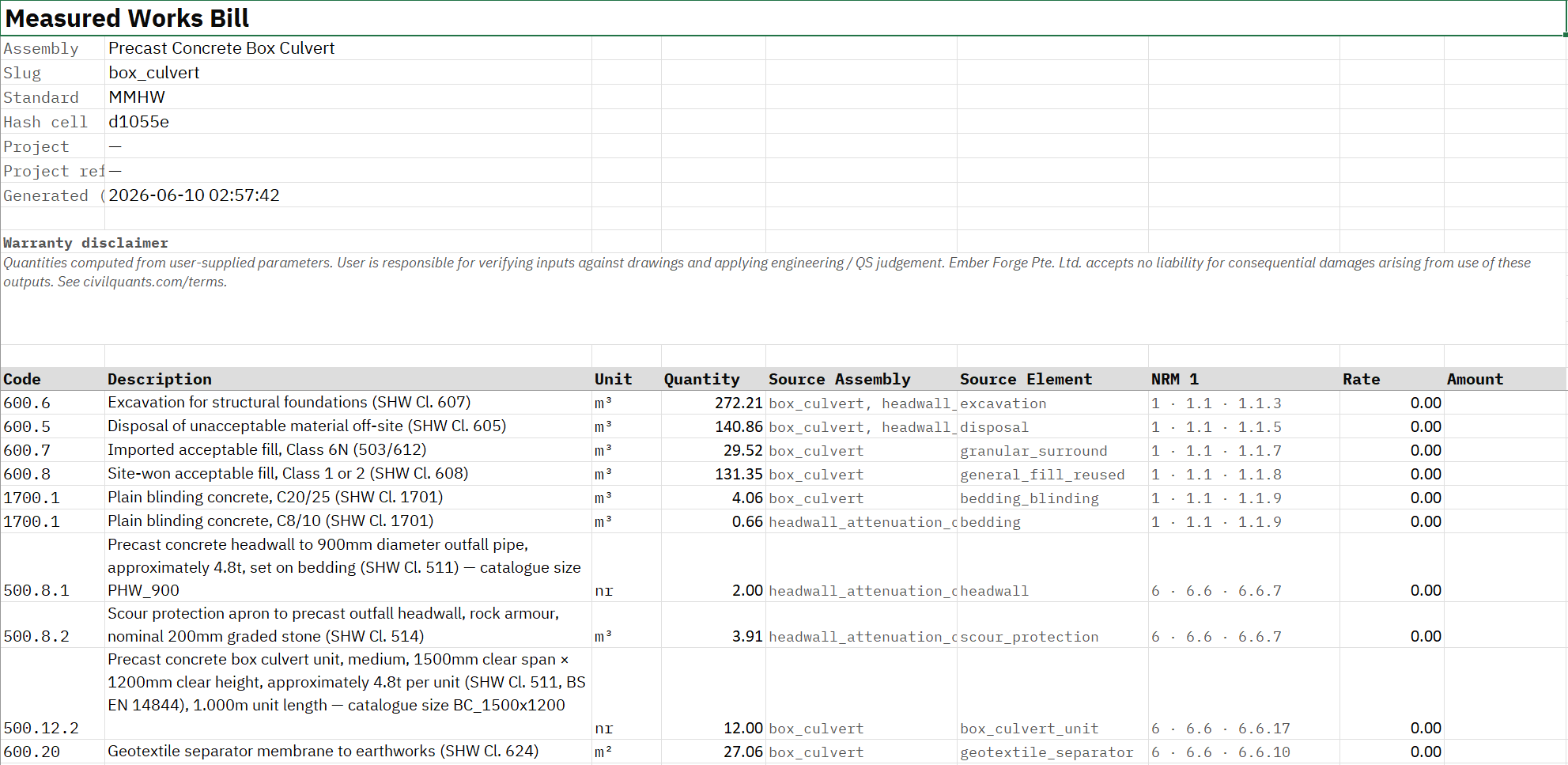
The MMHW bill (hash d1055e): the 272.21 m³ structural dig in Series 600, the 12 barrel units and the 2 headwalls as separate enumerated rows, and the scour protection.
Why the barrel and the ends stay apart
The barrel is 12 enumerated units; the headwalls are 2 enumerated units; the blinding under the barrel (4.06 m³) and the bedding under the headwalls (0.66 m³) are separate concrete rows. Folding the headwalls and their bedding into a single "culvert" line is the classic leak: the end structures are real concrete and real money, and a barrel-only line drops a structure at each end. CESMM4 splits the same work across classes (the precast units and concrete in the structures and concrete classes, the earthworks in Class E), but the principle holds in either: barrel, ends, bedding, scour, earthworks. Only the codes change.
Precast versus in-situ, box versus pipe
The example is precast, which is how most UK accommodation and watercourse culverts are now built: the units arrive as 4.8 t sections and are craned in, so the barrel is enumerated per unit. An in-situ reinforced concrete box is measured differently, as in-situ concrete by volume, reinforcement by tonne and formwork by area.
A pipe culvert is the same idea with a pipe instead of a box. The barrel becomes a linear, depth-banded pipe run, and under MMHW piped drainage is banded by both bore and depth: a deeper invert pushes the same bore into the next band at a different rate. So getting the average invert depth right is not a refinement, it is what decides which rate the pipe is priced against. The bedding, surround and the same two end structures are then added as their own items. The honest framing: a box culvert is one composed assembly, while a pipe culvert is assembled from the pipe line plus its bedding plus its end structures. Both end up with the same six components on the bill.
Common errors
- Billing the barrel, forgetting the ends. A headwall at each end is real concrete and real money. Compose the culvert so the ends appear on the bill automatically.
- Wrong depth band on the pipe. Pipe runs are banded by average invert depth. A guessed depth puts the pipe in the wrong band and misprices it. Measure the depth, do not assume it.
- Trench rule on a structural dig. A culvert is a structural foundation, measured to Series 600.6 (SHW Cl. 607), not the pipe-trench rule. Using the wrong rule under-measures the working space and batter.
- Granular surround left out. The selected fill around the barrel is a separate, imported material from the general backfill over it. Folding them together hides the import cost.
FAQ
How do you measure a culvert in a BoQ? As six components: excavation, bedding and surround, the barrel (box units or pipe run), the end structures (headwalls and wing walls), scour protection, and backfill. Measure each, and band the pipe by bore and depth.
Box versus pipe culvert, how does the bill differ? A precast box culvert is enumerated by unit and size band, and a single composed assembly can return the whole crossing. A pipe culvert is a linear, depth-banded pipe run, with the bedding, surround and end structures added as separate items.
Are headwalls and wing walls measured with the culvert or separately? They are separate items on the bill, but they belong to the culvert. The cleanest approach is to compose the culvert so the end structures appear automatically, so they are never forgotten.
Why is the excavation measured to the structures rule? A culvert sits in a structural foundation, so the dig follows Series 600.6 (SHW Cl. 607), with working space each side and a battered face, not the narrower pipe-trench rule. That is why a 12 m barrel 2.5 m deep returns 272.21 m³ of dig, not a trench volume.
Is scour protection included? It should be billed explicitly, as a rock-armour, gabion or concrete apron at each outfall. Leaving it out is a common source of mid-build variations.
Which standard suits culvert measurement? MMHW for highway and most infrastructure culverts (Series 500 for the barrel, Series 600 for earthworks); CESMM4 for general civil engineering, splitting the work across the structures, pipework and earthworks classes. The components are identical, only the coding differs.
Does the bill include a flow-control orifice? Not by default. A plain conveyance culvert carries no flow-control item; the orifice plate is an opt-in addition for an attenuation outlet, so a standard culvert bill does not show one.
Try it
Measure a culvert and its end structures in one place. Box culvert is a paid assembly, so the worked standards (MMHW, CESMM4, NRM2, SMM7) need a pass or subscription. Start a 7-day pass for £15, or try a free assembly to MMHW with no sign-up, then open the box culvert calculator.
Frequently asked questions
- How do you measure a culvert in a BoQ?
- As six components: excavation, bedding and surround, the barrel (box units or pipe run), the end structures (headwalls and wing walls), scour protection, and backfill. Measure each, and band the pipe by bore and depth.
- Box versus pipe culvert, how does the bill differ?
- A precast box culvert is enumerated by unit and size band, and a single composed assembly can return the whole crossing. A pipe culvert is a linear, depth-banded pipe run, with the bedding, surround and end structures added as separate items.
- Are headwalls and wing walls measured with the culvert or separately?
- They are separate items on the bill, but they belong to the culvert. The cleanest approach is to compose the culvert so the end structures appear automatically, so they are never forgotten.
- Why is the excavation measured to the structures rule?
- A culvert sits in a structural foundation, so the dig follows Series 600.6 (SHW Cl. 607), with working space each side and a battered face, not the narrower pipe-trench rule. That is why a 12 m barrel 2.5 m deep returns 272.21 m³ of dig, not a trench volume.
- Is scour protection included?
- It should be billed explicitly, as a rock-armour, gabion or concrete apron at each outfall. Leaving it out is a common source of mid-build variations.
- Which standard suits culvert measurement?
- MMHW for highway and most infrastructure culverts (Series 500 for the barrel, Series 600 for earthworks); CESMM4 for general civil engineering, splitting the work across the structures, pipework and earthworks classes. The components are identical, only the coding differs.
- Does the bill include a flow-control orifice?
- Not by default. A plain conveyance culvert carries no flow-control item; the orifice plate is an opt-in addition for an attenuation outlet, so a standard culvert bill does not show one.