How to Measure Outfall Headwalls in a BoQ (with Worked Example)
An outfall headwall is a composite, not a line. It is a back wall pierced by the outfall pipe, splayed wing walls flaring downstream, an apron slab, and the scour protection that stops the discharge undermining the structure. Each part is measured to its own rule: the excavation and backfill in earthworks, the back wall, apron and wing walls in in-situ concrete, the bar in reinforcement, the faces in formwork, and the rock armour as a separate item. This post shows the exact rows under CESMM4, with a real worked example you can reproduce, and the item most estimators forget.
For the wider document see a civil engineering Bill of Quantities; for a closely related composite, see how to measure drainage chambers.
What a headwall is, and its parts
A reinforced concrete outfall headwall has four working parts:
- The back wall, the vertical face that retains the embankment and carries the pipe opening.
- The wing walls, splayed out from the back wall to retain the flanks and guide flow.
- The apron, a slab in front of the structure that takes the discharge and resists scour at the toe.
- The scour protection, usually rock armour, laid downstream of the apron where the water leaves the structure.
Each is concrete you can measure, except the scour protection, which is a graded-stone item in its own right. Miss any one and the bill is short.
Measuring it under CESMM4
The headwall below is an in-situ reinforced concrete outfall headwall for a 300 mm pipe (400 mm outside diameter), with the calculator default geometry: a 2.5 by 1.5 m back wall 300 mm thick, a 2.0 m apron, 1.5 m wing walls splayed at 30 degrees, and a rock-armour scour apron, all in C32/40 concrete, measured to CESMM4. The quantities are real CivilQuants engine output, generated for this article. Treat them as a modelled example for illustration, not a tender; every number is reproducible from the same geometry. CESMM4 output is a paid-tier render; the free tier measures the same headwall to MMHW.
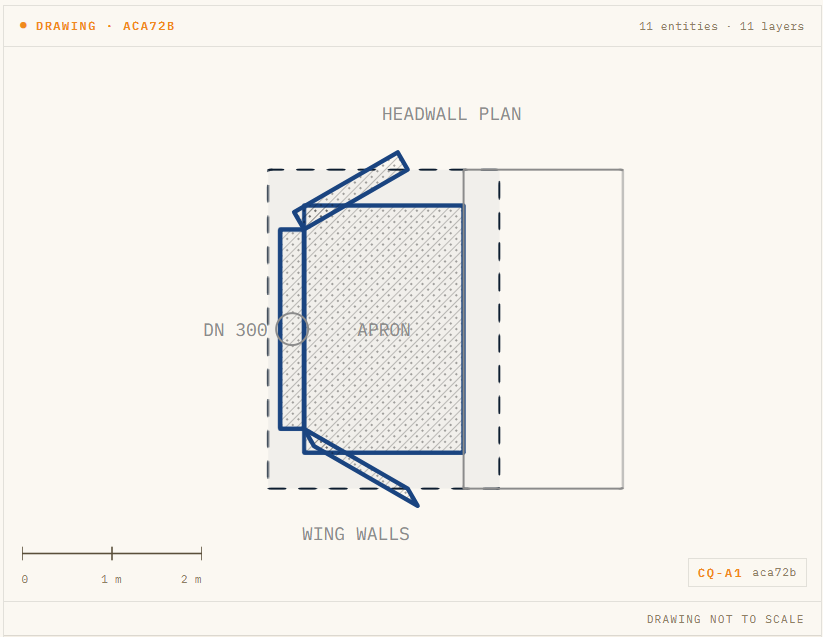
The headwall drawing (hash aca72b): the back wall with the pipe opening, the two splayed wing walls, and the apron in front of the structure.
| CESMM code | Description | Quantity | Unit |
|---|---|---|---|
| E.4.3.2 | Excavation for foundations, maximum depth 0.25 to 0.5 m | 3.77 | m³ |
| E.5.3 | Disposal of excavated material off-site | 2.02 | m³ |
| E.6.2.1 | Filling, excavated material | 1.75 | m³ |
| F.1.1.1 | In-situ concrete blinding, C8/10, thickness 75 mm | 0.46 | m³ |
| F.6.2.3 | In-situ reinforced concrete C32/40, headwall back wall | 1.09 | m³ |
| F.6.2.3 | In-situ reinforced concrete C32/40, headwall apron | 1.55 | m³ |
| F.6.2.3 | In-situ reinforced concrete C32/40, headwall wing walls | 0.68 | m³ |
| G.5.1.4 | Reinforcement, high-yield bar to BS 4449 grade B500B, 12 mm diameter | 0.2108 | t |
| G.5.1.5 | Reinforcement, high-yield bar to BS 4449 grade B500B, 16 mm diameter | 0.0879 | t |
| G.1.4 | Formwork to vertical and battered faces | 17.6 | m² |
| E.4.1 | Scour protection apron, rock armour, nominal 200 mm graded stone | 2.40 | m³ |
The three concrete rows are listed separately, back wall, apron and wing walls, so the 3.32 m³ of structural concrete is traceable to its parts rather than presented as a single lump. The reinforcement is shown by bar diameter, 0.2108 t of 12 mm and 0.0879 t of 16 mm, about 0.30 t in total, and the formwork to the vertical and battered faces is its own measured item under Class G, not folded into the concrete.
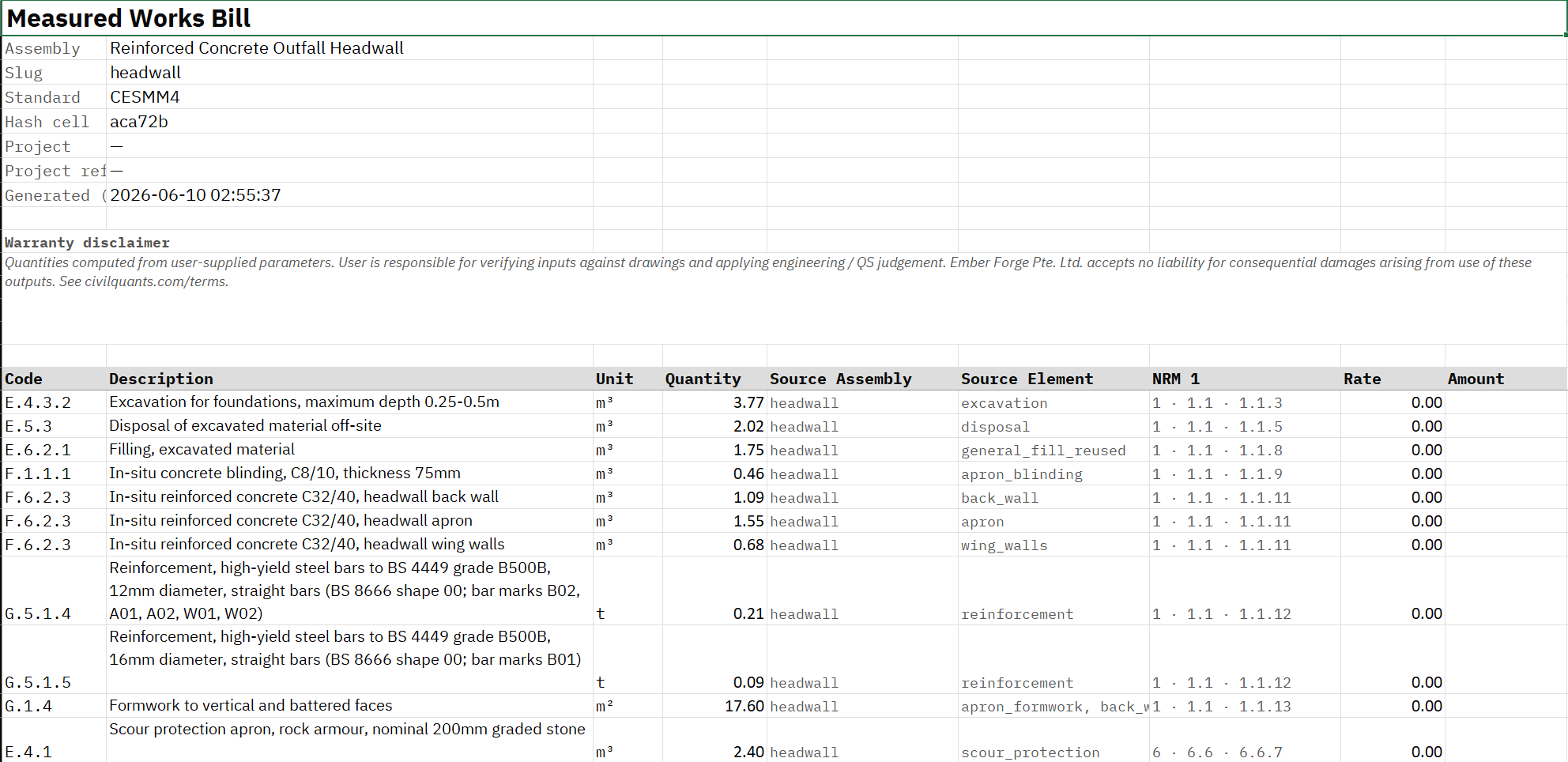
The CESMM4 bill (hash aca72b): back wall, apron and wing walls as separate Class F rows, the reinforcement split by bar diameter, and the 2.40 m³ of rock armour.
The scour protection nobody bills
The single most commonly missed item on a headwall is the rock armour. It is not concrete, so it slips past an estimator working down a concrete take-off, but it is the item that keeps the structure standing once water is running through it. Here it is 2.40 m³ of nominal 200 mm graded stone, measured separately. On a real outfall it is rarely optional, and leaving it out understates both the bill and the buildability of the design. CivilQuants includes it as a default item precisely because it is so easy to forget.
In-situ versus precast
The example above is an in-situ headwall, poured in place with formwork. A precast headwall replaces the in-situ concrete and formwork rows with a single supplied-and-installed unit, which changes the bill significantly: the concrete, reinforcement and formwork rows collapse into a precast item, while the excavation, backfill and scour protection stay. Which you choose depends on the pipe size, access and programme. The measurement follows the construction method, so decide the method first, then measure to it.
Common errors
- Forgetting the scour protection. The classic miss. It is a separate graded-stone item, not part of the concrete.
- Billing the wing walls as part of the back wall. They are separate pours with their own geometry and reinforcement; measure them separately so the concrete is traceable.
- Dropping the formwork. The vertical and battered faces are a measured Class G item. Folding them into the concrete rate hides them.
- Wrong pipe opening. The back wall is pierced for the outfall pipe; the opening must match the pipe outside diameter, not the bore.
FAQ
What is an outfall headwall? A reinforced concrete structure at the end of a pipe or culvert outfall, comprising a back wall with the pipe opening, splayed wing walls, an apron and scour protection, that retains the embankment and protects against erosion.
How is a headwall measured in a BoQ? As a composite: excavation and backfill in earthworks, the back wall, apron and wing walls in in-situ concrete, the reinforcement and formwork in concrete ancillaries, and the rock-armour scour protection as a separate graded-stone item.
What scour protection does a headwall need? Typically rock armour, a graded-stone blanket laid downstream of the apron where the discharge leaves the structure. It is measured by volume and is easy to omit.
Should I use an in-situ or precast headwall? It depends on pipe size, site access and programme. The measurement follows the method: in-situ gives concrete, reinforcement and formwork rows; precast gives a single supplied-and-installed unit.
Which CESMM4 classes does a headwall use? Class E for excavation, backfill and scour protection; Class F for the in-situ concrete; Class G for reinforcement and formwork.
How big does the pipe opening need to be? It is sized on the pipe outside diameter, not the internal bore, so the structure fits the actual pipe. The default example takes a 300 mm pipe with a 400 mm outside diameter.
Why are the reinforcement rows split by bar size? Because CESMM measures reinforcement by diameter, so the 12 mm and 16 mm bar are separate rows, here 0.2108 t and 0.0879 t. Splitting them lets a pricing estimator apply the right rate to each diameter.
Try it
Build a headwall from geometry and read its bill. Start a 7-day pass for £15, or try a free assembly to MMHW with no sign-up, then open the headwall calculator.
Frequently asked questions
- What is an outfall headwall?
- A reinforced concrete structure at the end of a pipe or culvert outfall, comprising a back wall with the pipe opening, splayed wing walls, an apron and scour protection, that retains the embankment and protects against erosion.
- How is a headwall measured in a BoQ?
- As a composite: excavation and backfill in earthworks, the back wall, apron and wing walls in in-situ concrete, the reinforcement and formwork in concrete ancillaries, and the rock-armour scour protection as a separate graded-stone item.
- What scour protection does a headwall need?
- Typically rock armour, a graded-stone blanket laid downstream of the apron where the discharge leaves the structure. It is measured by volume and is easy to omit.
- Should I use an in-situ or precast headwall?
- It depends on pipe size, site access and programme. The measurement follows the method: in-situ gives concrete, reinforcement and formwork rows; precast gives a single supplied-and-installed unit.
- Which CESMM4 classes does a headwall use?
- Class E for excavation, backfill and scour protection; Class F for the in-situ concrete; Class G for reinforcement and formwork.
- How big does the pipe opening need to be?
- It is sized on the pipe outside diameter, not the internal bore, so the structure fits the actual pipe. The default example takes a 300 mm pipe with a 400 mm outside diameter.
- Why are the reinforcement rows split by bar size?
- Because CESMM measures reinforcement by diameter, so the 12 mm and 16 mm bar are separate rows, here 0.2108 t and 0.0879 t. Splitting them lets a pricing estimator apply the right rate to each diameter.