How to Measure Drainage Chambers in a BoQ (with CESMM4 Worked Example)
A drainage chamber, a manhole, is not a single BoQ line. It is a composite of measured items across earthworks, concrete, reinforcement and drainage, each measured to its own rule. Under CESMM4 the chamber unit and its ancillaries sit in Class K (manholes and pipework ancillaries), with the excavation, concrete and reinforcement carried by their own classes; under MMHW the same chamber is measured to the relevant SHW Series clauses. This post shows the exact rows that appear, a real worked example you can reproduce, and the assumptions that move the numbers.
For the wider document, see a civil engineering Bill of Quantities; for the classification rules behind the codes, see the step-by-step CESMM4 guide.
A manhole is a composite, not a line
Bill a manhole as one item and you have hidden most of its cost. The constituent measured items for a typical precast chamber are:
- Excavation, and disposal of what cannot be reused
- Backfill, site-won where acceptable, imported where not
- Blinding, then reinforced concrete to the base slab, reducing slab, cover slab and benching
- Reinforcement to those slabs
- The precast chamber unit itself
- Step irons or a ladder, and the pre-formed invert channel
- Granular surround and a geotextile separator
- A Prime Cost item for the frame and cover
Nine or more measured rows, across several work classes. Treat it as one line and the bill is neither checkable nor comparable.
Measuring it under CESMM4
The chamber below is a 1,500 mm internal-diameter precast manhole, 3.5 m to invert, D400 cover, measured to CESMM4 at the calculator's default geometry. The quantities are real CivilQuants engine output, generated for this article. Treat them as a modelled example for illustration, not a tender; every number is reproducible from the same geometry. The rows below are the principal ones; the engine's full bill also splits the concrete and reinforcement by element and carries a small imported-fill top-up.
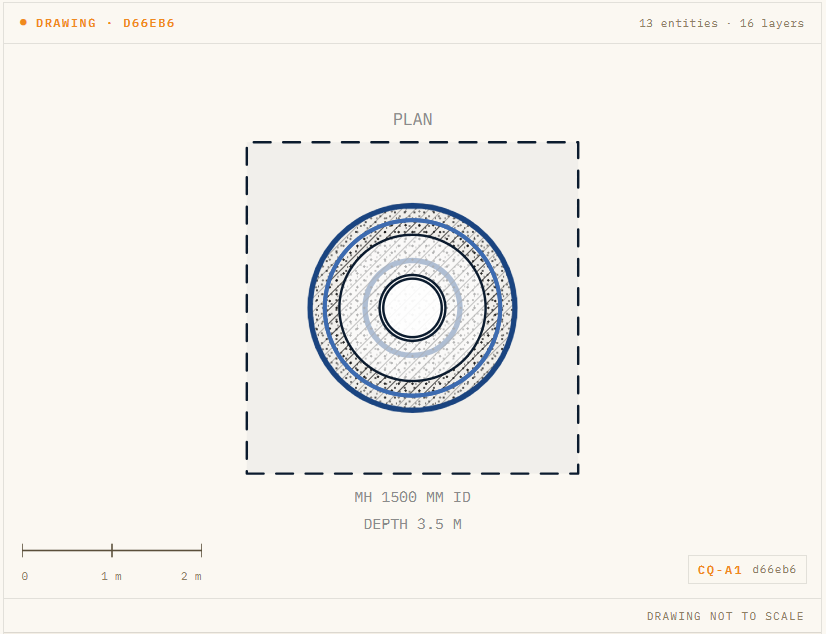
The default 1500 mm manhole as the engine draws it. The hash cell (d66eb6) ties this drawing to the bills below.
| CESMM code | Description | Quantity | Unit |
|---|---|---|---|
| A.4.1 | Prime Cost sum: frame and cover, D400, 600 mm clear opening | 1 | sum |
| E.4.3.5 | Excavation for foundations, maximum depth 2 to 5 m | 105.54 | m³ |
| E.5.3 | Disposal of excavated material off-site | 7.36 | m³ |
| E.6.2.1 | Filling, excavated material | 98.18 | m³ |
| F.1.1.1 | In-situ concrete blinding, C8/10, 75 mm | 0.26 | m³ |
| F.6.2.3 | In-situ reinforced concrete C32/40, base, reducing, cover slabs and benching | 1.54 | m³ |
| G.5.1 | Reinforcement, B500B high-yield bar | 0.104 | t |
| L.5.2 | Granular surround, 20 mm single-size aggregate | 3.22 | m³ |
| K.1.1.3 | Precast concrete manhole, 1,500 mm internal diameter, 3.5 m to invert | 1 | nr |
| K.8.1 | Galvanised step irons, 300 mm centres | 10 | nr |
| K.5.1 | Pre-formed channel to invert, 300 mm diameter | 1 | nr |
| E.7.2 | Geotextile filter, 200 g/m², including laps | 25.4 | m² |
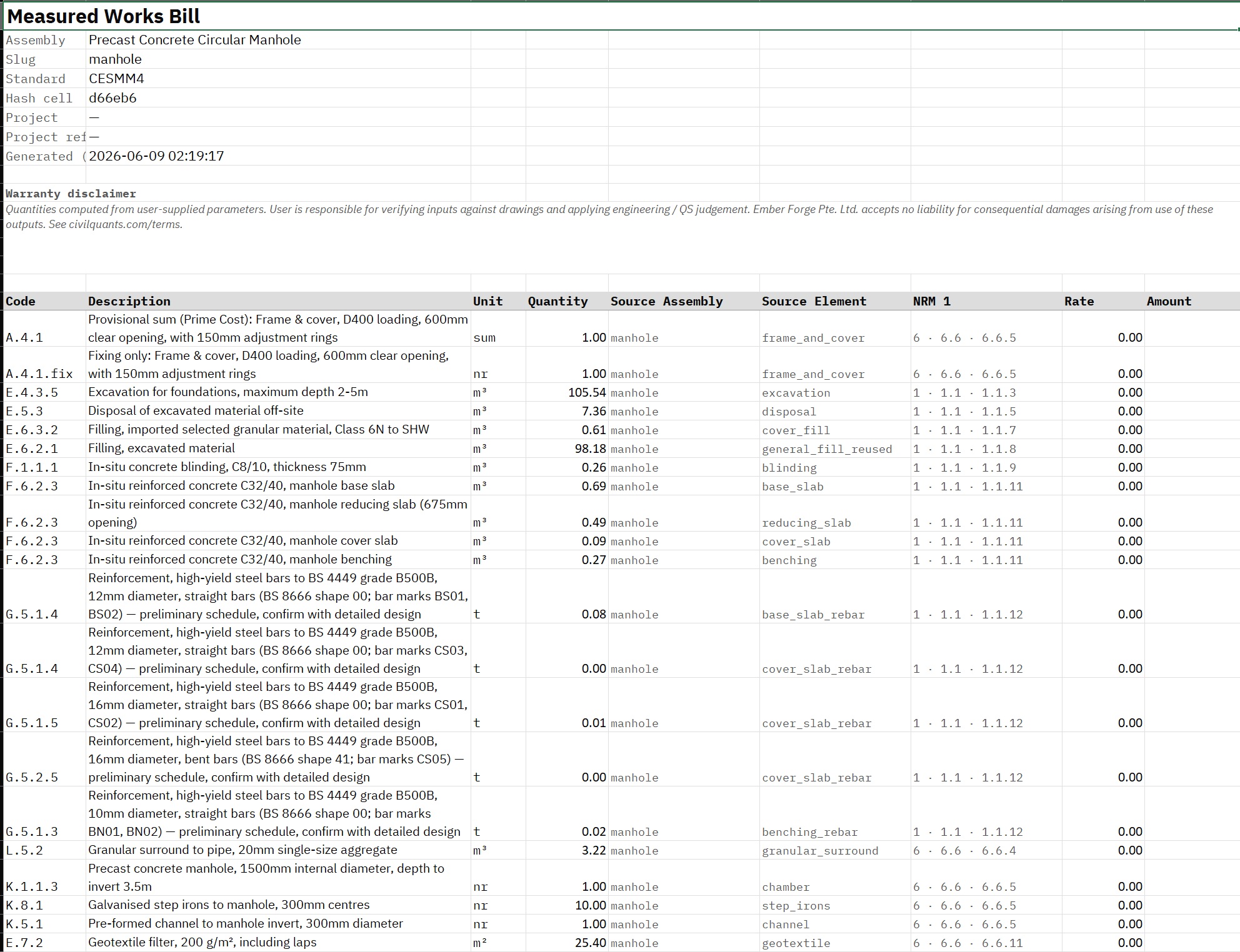
The full CESMM4 bill the engine renders for this chamber, every row coded automatically to its class.
The chamber unit, step irons and channel are the Class K items. Everything else is carried by Class E (earthworks), Class F (concrete), Class G (reinforcement) and Class L (granular surround). One physical object, five work classes.
Measuring it under MMHW
The same chamber measured to MMHW gives the same quantities and a different coding. The rows below are the MMHW version, again real engine output.
| SHW ref | Description | Quantity | Unit |
|---|---|---|---|
| 2704 | Prime Cost item: frame and cover, D400, 600 mm clear opening | 1 | sum |
| 600.6 | Excavation for structural foundations (SHW Cl. 607) | 105.54 | m³ |
| 600.5 | Disposal of unacceptable material off-site (SHW Cl. 605) | 7.36 | m³ |
| 600.8 | Site-won acceptable fill, Class 1/2 (SHW Cl. 608) | 98.18 | m³ |
| 1700.4 | Reinforced in-situ concrete C32/40, base, reducing, cover slabs and benching (SHW Cl. 1704) | 1.54 | m³ |
| 1700.7 | Steel reinforcement, B500B, to BS 8666:2020 (SHW Cl. 1717) | 0.104 | t |
| 500.3 | Granular surround to pipes (SHW Cl. 503) | 3.22 | m³ |
| 500.5.3 | Precast concrete chamber, 1,500 mm i.d., 3.5 m deep (SHW Cl. 507) | 1 | nr |
| 500.6.2 | Galvanised step irons, 300 mm centres (SHW Cl. 509) | 10 | nr |
| 500.20 | Filter geotextile (SHW Cl. 513) | 25.4 | m² |
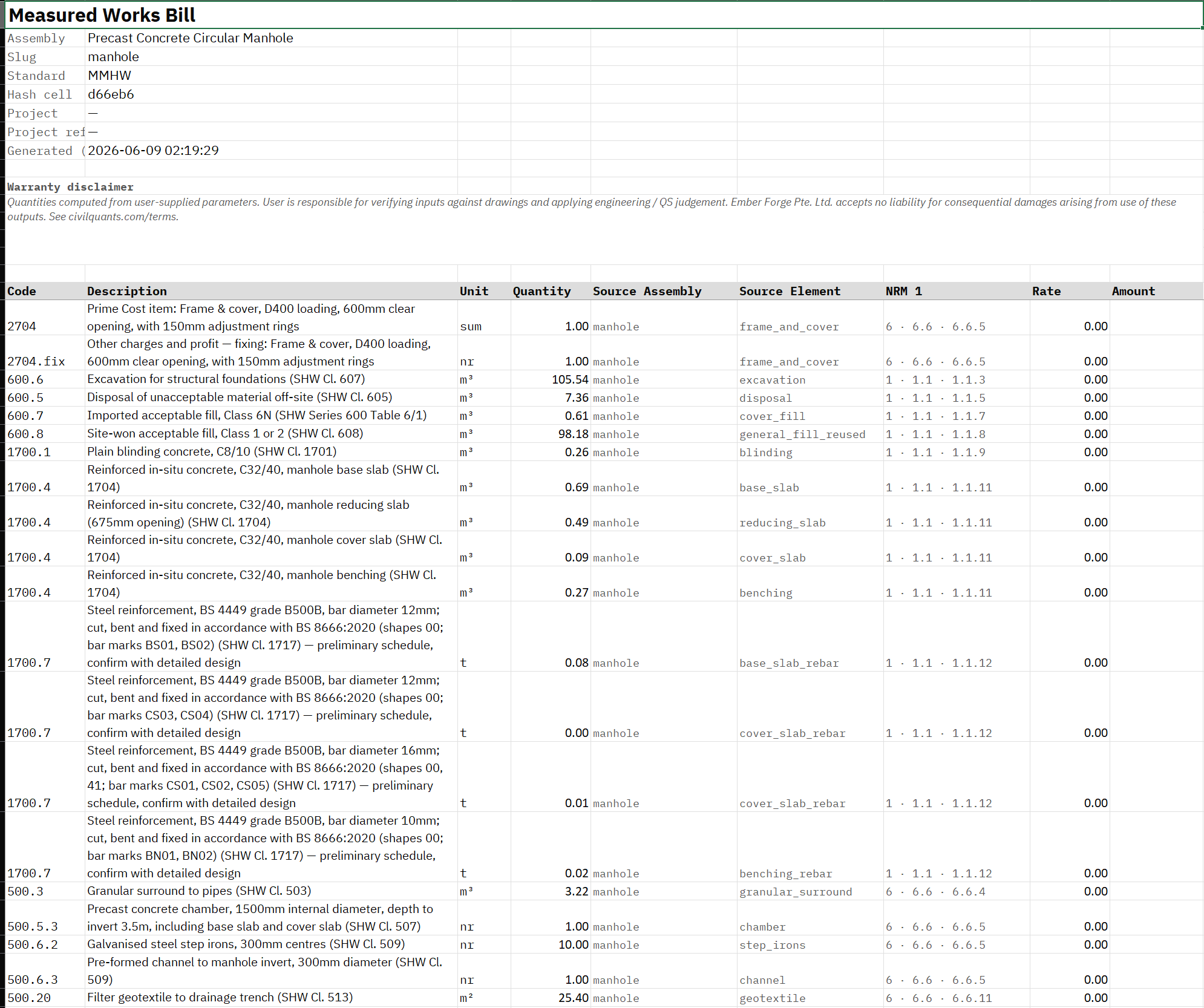
The same chamber to MMHW: identical quantities, Series/SHW-clause coding instead of CESMM4 classes.
Read the two tables together and the lesson is plain: the excavation is 105.54 m³ in both, the reinforced concrete is 1.54 m³ in both, the chamber is one unit in both. The standard changes the reference (Class K versus SHW Series 500, and so on) and the description, not the physical quantity. For the MMHW conventions in full, see the MMHW method of measurement.
The assumptions that move the numbers
Two estimators measuring the same chamber often bill different quantities, and the reason is almost always an unstated assumption. The ones that matter most here:
- Excavation support. This bill assumes open-batter excavation with a working space each side. Switch to vertical, sheet-piled support and both the excavation (105.54 m³) and the disposal quantity change, because the dig geometry changes. State which you have assumed.
- Cover loading. A D400 cover is assumed (carriageway loading). A heavier E600 or lighter B125 changes the frame and cover Prime Cost item.
- Reducing slab and rebar density. A reducing slab and a default reinforcement intensity drive the concrete and steel rows. Change the design and they move.
The point of showing the assumption is that a commercial query on any row can be answered from the bill itself. CivilQuants lists every assumption alongside the quantities, so the 105.54 m³ is never a number anyone has to take on trust.
Common errors
- Forgetting the disposal-versus-reuse split. Not all the dig is acceptable backfill. Here 98.18 m³ is reused and 7.36 m³ goes off-site; bill them separately.
- Missing the frame and cover Prime Cost item. It is a supplied item, billed as a PC sum, not folded into the chamber rate.
- Wrong cover loading class. D400 for a carriageway, lighter for a verge or footway. The wrong class misprices the cover.
- Ignoring working space. Bill the dig to the structure face only and you under-measure the excavation and the backfill both.
Try it
Measure this exact manhole yourself, free, to MMHW, with no sign-up, then unlock CESMM4, NRM2 and SMM7 with a 7-day pass for £15. Open the manhole calculator.
Frequently asked questions
- How do you measure a manhole in a Bill of Quantities?
- As a composite of measured items: excavation, disposal, backfill, blinding, reinforced concrete, reinforcement, the precast chamber unit, step irons, channel, granular surround, geotextile, and a Prime Cost item for the frame and cover.
- Which CESMM4 work class covers manholes?
- Class K, manholes and pipework ancillaries. The chamber unit, step irons and channel are billed there; the excavation, concrete and reinforcement sit in Classes E, F and G.
- How is excavation for a manhole measured?
- By volume, in a depth band, to the assumed excavation support and working space. Open-batter and sheet-piled digs give different volumes for the same chamber.
- What is a Prime Cost item for a frame and cover?
- A sum included for a supplied item whose final cost is set later, billed separately from the labour to fix it.
- How does the cover loading class affect the bill?
- It sets the frame and cover specification. D400 is carriageway loading; lighter classes suit verges and footways. The class changes the Prime Cost item.
- Why do two estimators get different manhole quantities?
- Almost always a different assumption on excavation support, working space or cover loading. Showing the assumption on the bill is what settles it.