MMHW Explained: How to Measure Highway Works for Tender
The Method of Measurement for Highway Works (MMHW) is the measurement basis for National Highways schemes. It tells you how to quantify highway works for a Bill of Quantities, and it reads alongside the Specification for Highway Works (SHW), so every measured item is tied to a numbered SHW clause. Where a general civil engineering job is measured to CESMM4, a National Highways job (and most highways framework work) is measured to MMHW. This guide explains what MMHW is, how its Series numbering works, when it applies, and how it differs from CESMM4, with a real worked example.
If you have not read what a civil engineering Bill of Quantities is, start there.
What MMHW is
MMHW is the method of measurement published within the Manual of Contract Documents for Highway Works (MCHW), the document set that governs National Highways construction contracts. Historically the MCHW was arranged in volumes, with the MMHW sitting in Volume 4. In the September 2025 modernisation, National Highways restructured the MCHW into an HTML format and retired the old volume arrangement, but the measurement content, and its tie to the SHW, are unchanged. You may still see "MMHW Volume 4" in older contract documents and references; it is the same method.
Two things make MMHW distinctive:
- It is published by National Highways and is Crown copyright, free to access and use on the Standards for Highways website. There is no licence fee to read or apply it, unlike the proprietary building and civil methods.
- It is inseparable from the SHW. The Specification for Highway Works defines how the work is built (materials, workmanship, tolerances) in numbered clauses; MMHW defines how that same work is measured. The two are read together, which is why an MMHW item carries an SHW clause reference.
The Series structure: how an MMHW item reads
MMHW and the SHW are organised into numbered Series, each covering a category of highway work. An item description points at the relevant Series and SHW clause, so an estimator pricing the bill knows exactly what specification they are pricing against. The Series you meet most:
- Series 600, Earthworks (excavation, disposal, fill, capping, formation).
- Series 500, Drainage and service ducts (pipes, chambers, beds and surrounds).
- Series 700, Pavements (sub-base, base, binder, surface courses).
- Series 1100, Kerbs, footways and paved areas.
- Series 1700, Structural concrete (in-situ and precast concrete, reinforcement).
- Series 400, Road restraint systems (safety barriers); Series 1200, Traffic signs and road markings; Series 1300, Road lighting, signs and bollards.
So a single highway structure spreads across Series. A manhole, measured to MMHW, reads like this (real CivilQuants engine output for a 1500 mm chamber, 3.5 m deep to invert, at the calculator's default geometry; a modelled example for illustration, not a tender, but reproducible). The table shows the principal row in each Series; the full bill carries more (a prime-cost sum for the frame and cover, the disposal and backfill, the blinding, a geotextile filter, and the reinforcement split out by bar diameter):
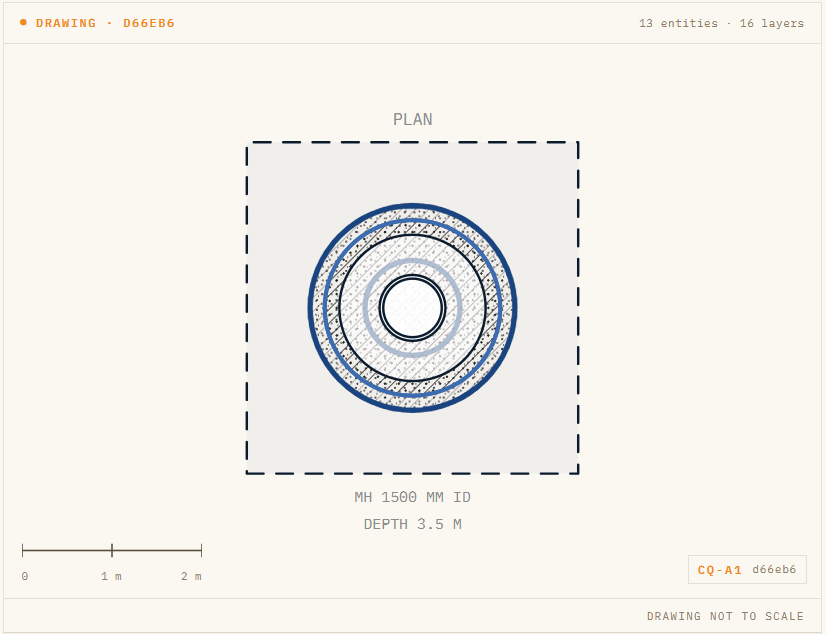
The default 1500 mm manhole as the engine draws it. The hash cell (d66eb6) ties this drawing to the MMHW bill below.
| MMHW ref | Description | Quantity | Unit |
|---|---|---|---|
| 500.5.3 | Precast concrete chamber, 1500 mm internal diameter, depth to invert 3.5 m, incl. base and cover slab (SHW Cl. 507) | 1 | nr |
| 600.6 | Excavation for structural foundations (SHW Cl. 607) | 105.54 | m³ |
| 1700.4 | Reinforced in-situ concrete, C32/40, base, reducing and cover slabs and benching (SHW Cl. 1704) | 1.54 | m³ |
| 1700.7 | Steel reinforcement, B500B, cut/bent/fixed to BS 8666 (SHW Cl. 1717) | 0.104 | t |
| 500.6.2 | Galvanised steel step irons, 300 mm centres (SHW Cl. 509) | 10 | nr |
| 500.3 | Granular surround (SHW Cl. 503) | 3.22 | m³ |
Read the first row: the Series reference (500.5.3), the SHW clause (Cl. 507), and a description that states the size and depth. That triple is the anatomy of every MMHW item. The clause tells the contractor which specification applies; the Series tells the QS which rules measured the quantity.
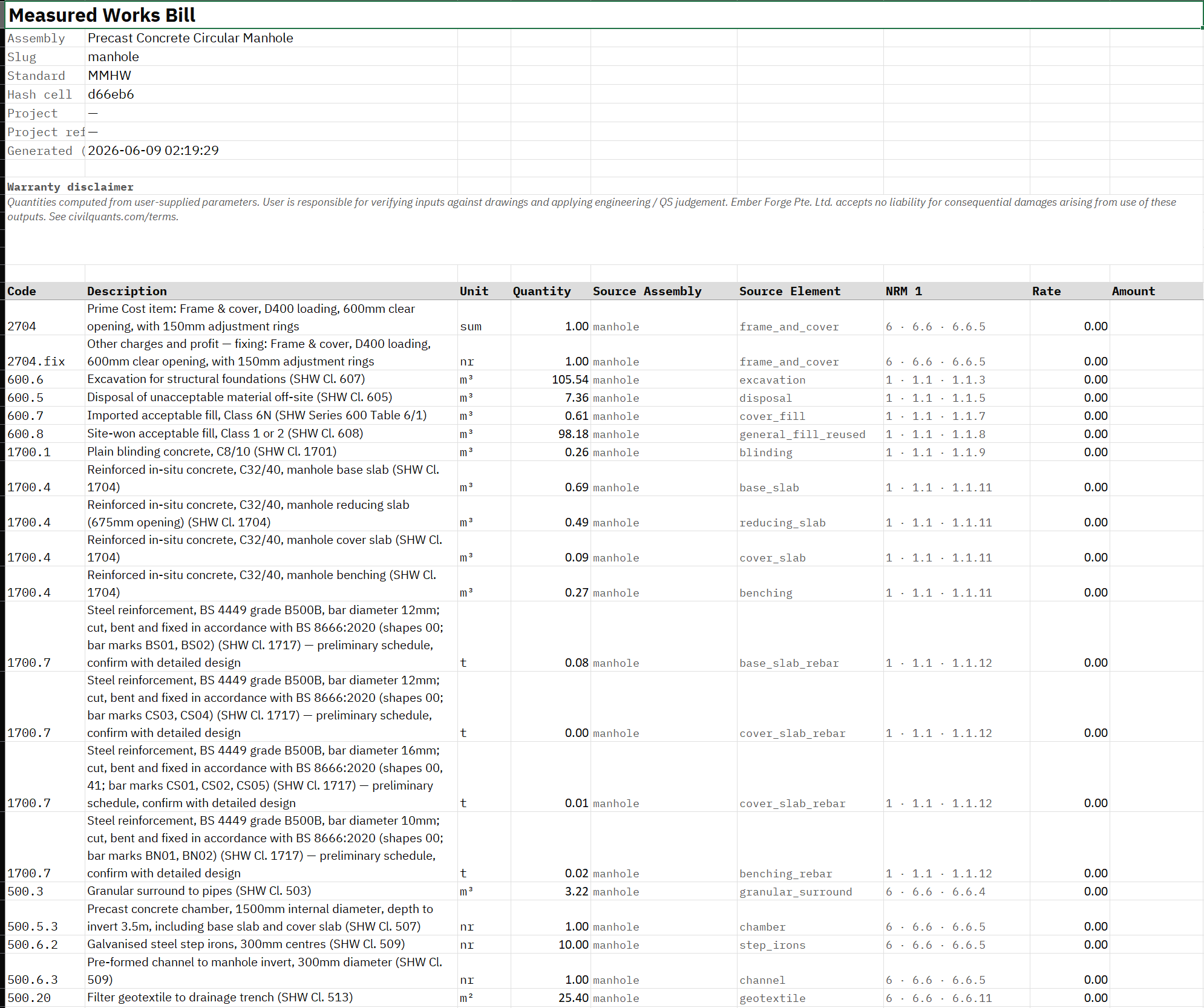
The full MMHW bill the engine renders for the same manhole. Every row carries its Series reference and SHW clause; the quantities are identical to the CESMM4 rendering, only the coding differs.
When MMHW applies
Use MMHW when the contract is a National Highways scheme or a highways framework that adopts the MCHW, which covers most strategic-road-network work and a large share of local-authority highway schemes that follow the same documents. For general civil engineering outside highways (water, structures, developer infrastructure on ICE or NEC contracts), the usual method is CESMM4. The contract documents decide: measure to what they specify, and do not substitute one method for another because it is more familiar.
How MMHW differs from CESMM4
Both are civil-side methods, and both produce a composite bill across categories. The differences that matter day to day:
- Description basis. MMHW ties each item to an SHW clause number; CESMM4 builds each item from a three-division coded classification (class letter plus further divisions). The same manhole is
500.5.3 (SHW Cl. 507)in MMHW andK.1.1.3in CESMM4. The quantity is identical; the coding differs. - What is deemed included. The two methods deem slightly different incidental work into the rates, so blindly porting a rate from one to the other can mis-state cost.
- The standards-drift risk. The single most common highways-bill error is measuring half the items to MMHW and half to a remembered CESMM4 rule. Pick the method the contract specifies and hold it across the whole bill. For the building-side comparison, see CESMM4 against NRM2.
Common errors on highway BoQs
- Standards drift. Mixing MMHW and CESMM4 rules within one bill. Hold a single method throughout.
- Dropping the SHW clause. An MMHW item without its clause reference is ambiguous about what specification is being priced.
- Forgetting the cross-Series spread. A highway structure is rarely one Series. A manhole touches 500, 600 and 1700; a culvert touches 500 and 600; a kerb run touches 1100, 1700 and 600.
- Guessed earthworks assumptions. Series 600 quantities depend on working space and batter. State them, or the quantity is unarguable.
Doing it faster
MMHW rewards consistency and punishes drift, which is exactly what a parametric engine is good at: every assembly renders to the right Series and SHW clause automatically, so a bill cannot quietly mix methods. The manhole above was generated in seconds and is reproducible from the same inputs, measured in accordance with MMHW. Because MMHW is the free, open standard, CivilQuants renders it on the free tier: you can measure six assemblies to MMHW with no sign-up. It is a tool for the estimator, not a replacement for one, and free-tier output is for research and illustration, not warranted for tender or contract use.
Try it
Measure highway works to MMHW free: six assemblies, no sign-up. Then unlock all four standards with a 7-day pass for £15, and build the worked manhole on the manhole calculator.
Frequently asked questions
- What does MMHW stand for?
- The Method of Measurement for Highway Works, the measurement basis published within the Manual of Contract Documents for Highway Works (MCHW) by National Highways.
- Is MMHW free to use?
- Yes. The MCHW, including MMHW and the SHW, is Crown copyright and free to access and use on the Standards for Highways website. There is no purchase or licence fee to apply it.
- Is MMHW still Volume 4 of the MCHW?
- It was, until the September 2025 MCHW modernisation, which moved the manual to HTML and retired the volume arrangement. Older contracts still say 'Volume 4'; it is the same method of measurement.
- When is MMHW used instead of CESMM4?
- On National Highways schemes and highways frameworks that adopt the MCHW. General civil engineering on ICE or NEC contracts typically uses CESMM4. The contract documents decide.
- What is the Specification for Highway Works?
- The SHW defines how highway work is built (materials, workmanship, tolerances) in numbered clauses. MMHW defines how that same work is measured, so the two are read together and an MMHW item carries an SHW clause reference.
- What is SHW Series 600?
- The earthworks Series: excavation, disposal, filling, capping and formation preparation. It is the Series most highway BoQs lean on hardest.
- How does an MMHW item description read?
- As a Series reference plus an SHW clause plus a description, for example 'Excavation for structural foundations (SHW Cl. 607)'. The clause fixes the specification; the Series fixes the measurement rule.