NRM2 vs CESMM4: The Five Differences That Actually Matter
Use CESMM4 for civil engineering works and NRM2 for building works. CESMM4 is the Civil Engineering Standard Method of Measurement, published by the Institution of Civil Engineers; NRM2 is the RICS New Rules of Measurement for detailed building measurement. They classify work differently, describe items differently, and treat method-driven cost differently. The physical quantity of a thing does not change between them; how it is coded, described and grouped does. This post covers the five differences that change how your bill reads, with the same foundation measured both ways so you can see them side by side.
If you want the underlying document first, read a civil engineering Bill of Quantities.
The one-line answer
If the works are roads, drainage, earthworks, structures, marine or pipelines, and the contract is ICE or NEC, you are in CESMM4 territory. If the works are a building, and the contract is JCT, you are in NRM2 territory. Mixed schemes happen, a building with significant external civils, and then you measure each part to the method that suits it rather than forcing one method across the whole job.
Difference 1: origin and scope
CESMM4 was written by civil engineers for civil engineering. Its categories assume excavation in depth bands, in-situ concrete in volume, pipework in runs, piling, and the temporary works that dominate heavy civils. NRM2 comes from the RICS and the building tradition, where the work breaks down by building element (substructure, frame, upper floors, finishes) and where the measurement conventions reflect how buildings are procured.
Apply the wrong one and the bill still adds up, but it stops matching how the work is actually done and priced, which is the whole point of using a standard method at all.
Difference 2: classification structure
CESMM4 sorts everything into the 26 CESMM4 work classes, lettered A to Z. Earthworks is Class E wherever it appears. NRM2 uses numbered work sections, and its substructure and concrete work sit in their own sections with their own numbering. The result is that the same physical item lands under a letter-based code in one method and a number-based code in the other.
Difference 3: item descriptions and depth banding
Both methods band excavation by depth, but they express the band differently. CESMM4 states a range with a floor and a ceiling, for example "maximum depth 0.5 to 1 m". NRM2 states a single "not exceeding" ceiling, for example "maximum depth not exceeding 1.00 m". The bands themselves are not aligned between the two rulesets, so an estimator who carries a CESMM habit into an NRM2 bill will band the same dig under a different threshold and produce a bill that looks subtly off to anyone pricing it.
Difference 4: method-related charges versus preliminaries
CESMM4 has an explicit category for method-related charges, costs tied to how the contractor does the work rather than to the measured quantity. That suits civils, where mobilising a piling rig or running dewatering can dominate. NRM2 handles this difference through its own preliminaries and the way it deals with work that cannot be quantified at tender. For heavy civils, CESMM's explicit split is usually the more honest fit.
Difference 5: how the same item actually looks
Here is the difference made concrete. Below is a single isolated reinforced concrete pad foundation, 2.0 m by 2.0 m by 0.45 m thick, measured to both methods. The quantities are real CivilQuants engine output at the calculator's default geometry, generated for this article. Treat them as a modelled example for illustration, not a tender, but every number is reproducible: enter the same geometry and you get the same bill.
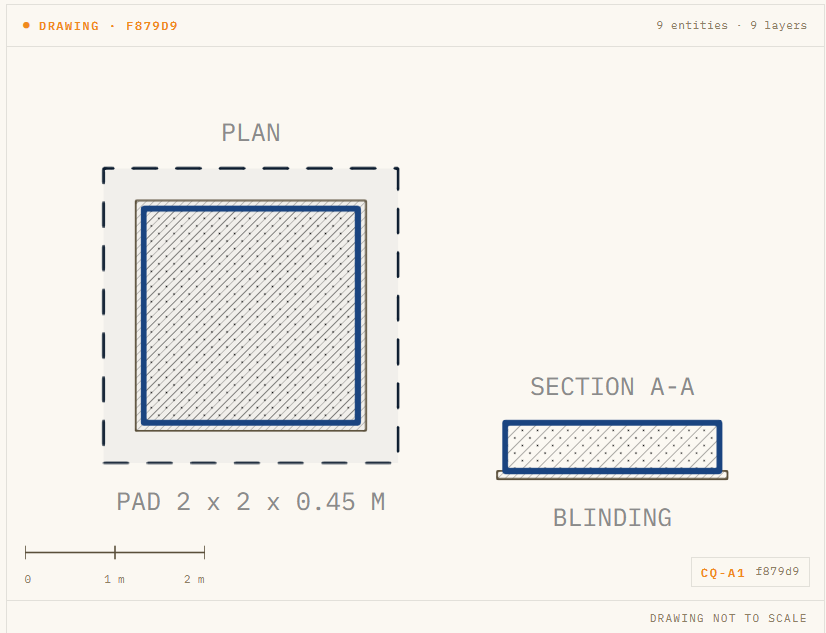
The default 2.0 × 2.0 × 0.45 m pad as the engine draws it: the pad on its blinding within the working-space excavation. The hash cell (f879d9) ties this drawing to the bill below.
| Item | Qty | Unit | CESMM4 code and description | NRM2 code and description |
|---|---|---|---|---|
| Excavation | 3.97 | m³ | E.4.3.3, excavation for foundations, maximum depth 0.5 to 1 m | 5.7.1, excavating for foundations, maximum depth not exceeding 1.00 m |
| Disposal off-site | 2.15 | m³ | E.5.3, disposal of excavated material off-site | 5.9.1, disposal of excavated material off-site |
| Filling | 1.82 | m³ | E.6.2.1, filling, excavated material | 5.11.1, filling, site-won granular, to make up levels |
| Blinding | 0.35 | m³ | F.1.1.1, in-situ concrete blinding C8/10, 75 mm | 11.1.1, plain in-situ concrete blinding C8/10 |
| Reinforced concrete | 1.80 | m³ | F.6.2.3, in-situ reinforced concrete C32/40 | 11.3.1, reinforced in-situ concrete C32/40 |
| Reinforcement | 0.12 | t | G.5.1.4 / G.5.1.5 / G.5.2.3, split by bar diameter and shape | 11.15.1, reinforcement bar, all diameters under one work section |
| Formwork | 3.6 | m² | G.1.4, formwork to vertical and battered faces | 11.13.1, formwork to faces of in-situ concrete, plain finish |
Read across any row and the quantity is identical, because the foundation is the same lump of concrete in the ground either way. What changes is the code and the description. Two details are worth pausing on. First, the excavation depth reads differently: CESMM4 states a band (0.5 to 1 m), NRM2 a ceiling (not exceeding 1.00 m). That is the classic place an estimator slips. Second, CESMM4 splits the reinforcement into separate rows by bar diameter and bending shape (12 mm and 16 mm straight bars, 10 mm bent links), while NRM2 groups it under a single work section. Same 0.12 t of steel, two ways of presenting it.
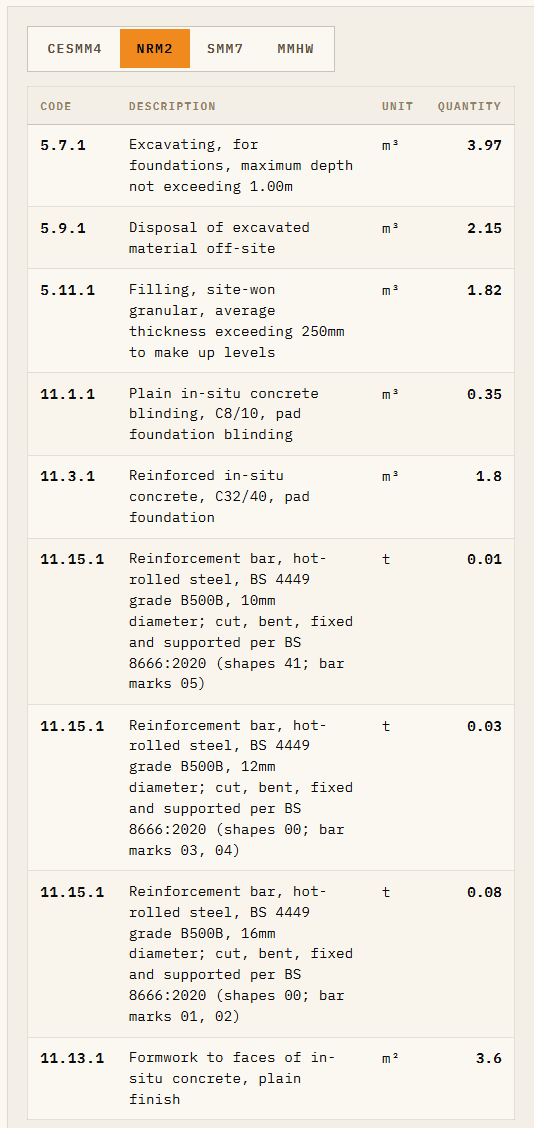
The same pad billed to NRM2 in CivilQuants. The CESMM4 rendering of the identical quantities is in the table above: one foundation, two rulebooks.
Which standard for which project
- Roads, drainage, earthworks, marine, pipelines, civils structures, ICE or NEC contract: CESMM4.
- Building works, JCT contract: NRM2.
- A building with substantial external works: measure the building to NRM2 and the external civils to CESMM4, and say so in the preliminaries.
- Legacy or client-specified method: follow the contract documents. If they name a method, that decides it.
For the history of how NRM2 came to replace the older building method, see why NRM2 replaced SMM7.
Try it
Measure the same item to both methods and compare. Start a 7-day pass for £15 to switch a single assembly between CESMM4, NRM2, SMM7 and MMHW, or try a free assembly to MMHW with no sign-up, then open the pad foundation calculator.
Frequently asked questions
- Is NRM2 better than CESMM4?
- Neither is better; they are for different work. CESMM4 is a civil engineering method, NRM2 a building method. Using the right one for the work is what matters.
- Can I measure civil engineering works with NRM2?
- You can, but the categories fit building work, so a heavy civils bill measured to NRM2 reads awkwardly and loses the method-related-charge structure that civils pricing relies on.
- Who publishes CESMM4 and NRM2?
- CESMM4 is published by the Institution of Civil Engineers through Thomas Telford. NRM2 is published by the Royal Institution of Chartered Surveyors.
- Do CESMM4 and NRM2 give different quantities?
- No. The measured quantity of a physical item is the same. The classification, coding, descriptions and grouping differ.
- Which contracts go with which method?
- CESMM4 pairs with ICE and NEC contracts; NRM2 pairs with JCT. The contract documents are the final word.
- What replaced SMM7?
- NRM2 replaced SMM7 in 2013. CESMM remains the civil engineering standard; NRM2 is the building method.