The 26 Work Classes in CESMM4, Explained in Plain English
CESMM4 classifies all civil engineering work into 26 work classes, lettered A to Z, from Class A (general items) through Class E (earthworks), F to H (concrete), I to L (pipework), to Class Z (simple building works incidental to civils). Each class sets the measurement rules and units for its category of work, so once you know which class an item belongs in, you know how to measure it. Below is the full A-to-Z list with a plain-English scope for each, then the classes you will actually use most, and how the three-division item code is built.
If you want the procedure rather than the reference, read the step-by-step CESMM4 guide. If you are new to bills entirely, start with what a civil engineering Bill of Quantities is.
How CESMM4 classification works
CESMM4 (the fourth edition of the Civil Engineering Standard Method of Measurement, published by the Institution of Civil Engineers through Thomas Telford) does two things to keep bills consistent. First, it sorts every item into one of 26 classes. Second, within a class, it builds each item description from a three-division coded classification: the class letter, then three further divisions that narrow the item to the exact thing being measured. Each class carries an "includes and excludes" list, a classification table, and a table of measurement rules.
The result is that two estimators given the same drawings produce bills that compare line for line, because the classification leaves no ambiguity about what each item is.
The 26 CESMM4 work classes, A to Z
| Class | Name | Plain-English scope |
|---|---|---|
| A | General items | Preliminaries, method-related charges, testing, temporary works not measured elsewhere. |
| B | Ground investigation | Trial pits, boreholes, sampling and in-situ testing. |
| C | Geotechnical and other specialist processes | Ground treatment, grouting, diaphragm walls, ground anchors. |
| D | Demolition and site clearance | Clearing the site, taking down structures, grubbing up. |
| E | Earthworks | Excavation, disposal, filling, landscaping, geotextiles. |
| F | In-situ concrete | The concrete itself: blinding, mass and reinforced concrete by volume. |
| G | Concrete ancillaries | Formwork, reinforcement, joints, finishes, inserts. |
| H | Precast concrete | Precast units: beams, slabs, copings, manhole rings. |
| I | Pipework, pipes | The pipe runs themselves, by bore and depth. |
| J | Pipework, fittings and valves | Bends, junctions, tapers, valves and hydrants. |
| K | Pipework, manholes and pipework ancillaries | Manholes, chambers, gullies, headwalls, outfalls. |
| L | Pipework, supports and protection, ancillaries to laying and excavation | Pipe beds and surrounds, protection, trench support, geotextiles to pipework. |
| M | Structural metalwork | Fabricated steelwork: frames, trusses, bracing. |
| N | Miscellaneous metalwork | Handrails, walkways, ladders, gratings. |
| O | Timber | Structural and other timber, decking, fendering. |
| P | Piles | Bored, driven and cast-in-place piles. |
| Q | Piling ancillaries | Pile testing, cutting down, pile caps and ancillary work. |
| R | Roads and pavings | Sub-base, base, surfacing, kerbs, footways, markings. |
| S | Rail track | Track, ballast, sleepers, switches and crossings. |
| T | Tunnels | Tunnel excavation, linings, support. |
| U | Brickwork, blockwork and masonry | Walling in brick, block and stone. |
| V | Painting | Protective and decorative coatings. |
| W | Waterproofing | Tanking, damp-proofing, membranes. |
| X | Miscellaneous work | Fences, gates, drainage to structures, signs and items not classed elsewhere. |
| Y | Sewer and water main renovation and ancillary works | Renovation, relining and repair of existing sewers and mains. |
| Z | Simple building works incidental to civil engineering works | Minor building work attached to a civils job. |
That table is the reference. Bookmark it, and use the class letter as your first decision on every item: which class does this belong in?
The classes you will use most
Most civils bills lean on a handful of classes:
- Class E, Earthworks. Excavation, disposal and filling appear on nearly every job. See how earthworks are measured.
- Classes F and G, Concrete and concrete ancillaries. The concrete (F) and then its formwork and reinforcement (G), kept deliberately separate. This split is where retaining walls and structures live; see how retaining walls are measured.
- Classes I to L, Pipework. The pipes (I), fittings (J), manholes and chambers (K), and beds, surrounds and supports (L). See how drainage chambers are measured.
- Class R, Roads and pavings. Carriageway and footway build-up, kerbs and markings. See how carriageway pavement layers are measured.
- Classes P and Q, Piling. Where the foundations need it.
Anatomy of a CESMM item code, and a Class K worked example
A manhole is a good teaching item because it spreads across several classes, and the chamber itself lands in Class K. Below is a 1500 mm precast manhole, 3.5 m deep to invert, measured to CESMM4 at the calculator's default geometry (real CivilQuants engine output; a modelled example for illustration, not a tender, but reproducible). The table shows the principal row in each class; the full bill carries more (a prime-cost sum for the frame and cover, the disposal and backfill, the blinding, a geotextile filter, and the reinforcement split out by bar diameter):
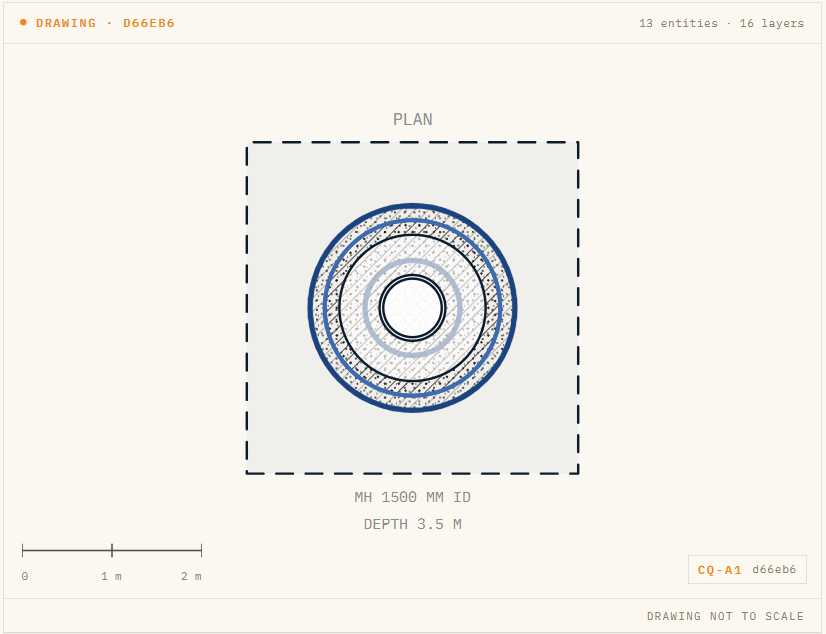
The default 1500 mm manhole as the engine draws it. The hash cell (d66eb6) ties this drawing to the bill and audit trail below.
| CESMM code | Description | Quantity | Unit |
|---|---|---|---|
| K.1.1.3 | Precast concrete manhole, 1500 mm internal diameter, depth to invert 3.5 m | 1 | nr |
| E.4.3.5 | Excavation for foundations, maximum depth 2 to 5 m | 105.54 | m³ |
| F.6.2.3 | In-situ reinforced concrete C32/40, base, reducing and cover slabs and benching | 1.54 | m³ |
| G.5.1.x | Reinforcement, B500B high-yield bar (10, 12 and 16 mm) | 0.104 | t |
| K.8.1 | Galvanised step irons, 300 mm centres | 10 | nr |
| K.5.1 | Pre-formed channel to invert, 300 mm diameter | 1 | nr |
| L.5.2 | Granular surround, 20 mm single-size aggregate | 3.22 | m³ |
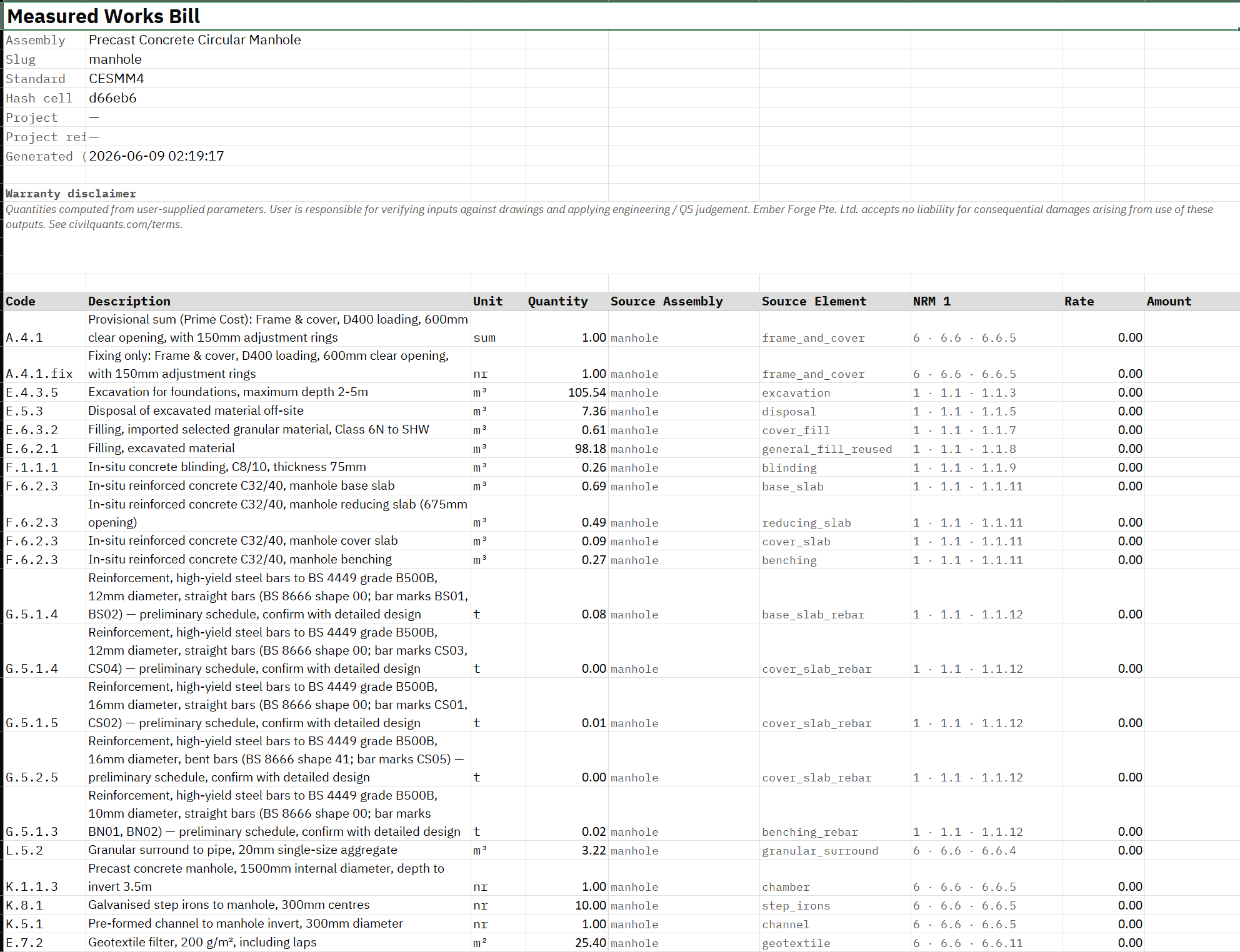
The full CESMM4 bill the engine renders for this manhole. The table above is the principal row per class; here is every row, coded automatically to its class.
Read the manhole code K.1.1.3. The class letter K says manholes and pipework ancillaries. The three divisions that follow narrow it to a precast manhole of a particular type and a depth band. Look at the excavation row, E.4.3.5: Class E, the first division identifies excavation for foundations, and the depth band 2 to 5 m is pinned by the later division, separating it from shallower or deeper digging that carry different rates. Code an item that way once and every estimator pricing the bill knows precisely what they are pricing.
Note also how one structure spreads across classes: the chamber, channel and step irons in K, the excavation in E, the concrete in F, the reinforcement in G, the surround in L. That spread is the whole point of the classification, and it is exactly what makes a hand take-off easy to get wrong.
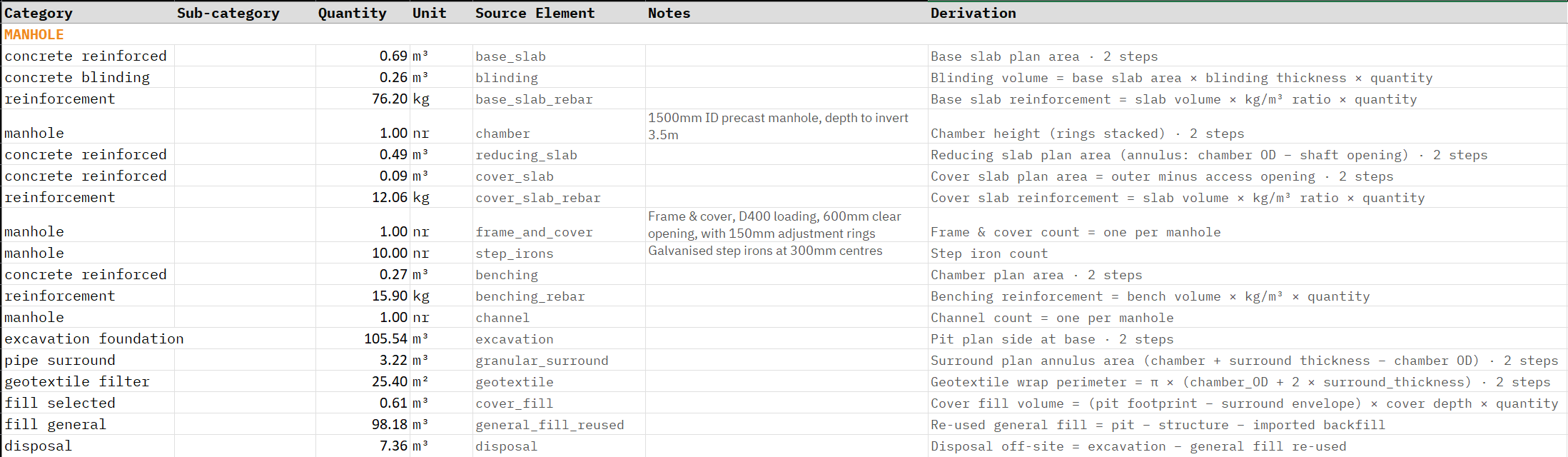
The audit trail behind the bill: every category traced to its derivation. This is what makes a quantity defensible, and what shows the class each row belongs to.
How CivilQuants maps to the classes
Every CivilQuants assembly renders its rows into the correct CESMM4 class automatically: a manhole's chamber lands in K, its excavation in E, its concrete in F and G, its surround in L, with no manual class lookup. The same geometry also renders to MMHW, NRM2 and SMM7, so the classification is applied consistently rather than from memory. Output is measured in accordance with CESMM4; it is a tool for the estimator, not a replacement for one. (CESMM4, NRM2 and SMM7 are paid-tier standards; MMHW is on the free tier.)
Try it
See your work land in the right CESMM4 class automatically. Start a 7-day pass for £15 for all four standards, and build the worked manhole on the manhole calculator.
Frequently asked questions
- How many work classes are in CESMM4?
- 26, lettered A to Z. Each class sets the measurement rules and units for a category of civil engineering work.
- What is CESMM4 Class E?
- Earthworks: excavation, disposal, filling, landscaping and associated geotextiles. It is the class most civils bills use most.
- Which CESMM4 class covers manholes?
- Class K (pipework, manholes and pipework ancillaries). It also covers gullies, headwalls and outfalls.
- Which CESMM4 class covers roads?
- Class R (roads and pavings): sub-base, base, surfacing, kerbs, footways and markings.
- What is the difference between a class and an item description?
- The class is the category (one of the 26 letters) that sets the rules and units. The item description is the specific item, built from the class letter plus three divisions that narrow it to the exact thing measured.
- Is the CESMM4 classification the same as CESMM3?
- The class structure is broadly continuous between editions, but the rules and detail were revised at each edition. Measure to the edition the contract specifies, and do not mix editions within a bill.