Footway BoQ: Measuring Pavement, Edging and Tactile Paving for Tender
A footway BoQ is the surfacing area plus everything at its edges and crossings. The bound surfacing is measured by area at a stated thickness, the sub-base and excavation by volume, the edgings and the kerb interface linearly, and the dropped kerbs and tactile paving at crossings as enumerated items plus area. Measure only the surfacing and you have left the edge restraint, the crossings and the tactiles off the bill, which is exactly where footway tenders come in short. This post walks the build-up, the edges and the crossings under MMHW, with real worked examples, and lists the items estimators most often miss.
For the wider document see a civil engineering Bill of Quantities; for the two details a footway borrows from the carriageway, see measuring a kerb run and measuring the carriageway pavement layers.
The footway build-up: measured by area
A footway is a thin pavement. Below grade it is formation preparation, then a granular sub-base, then the bound surfacing. The bound layers are measured by area at a stated compacted thickness; the sub-base by volume; the excavation by volume.
- Formation, prepared and proof-rolled
- Sub-base, granular Type 1 (Class 1A), spreading the load to the subgrade
- Base, dense asphalt concrete
- Binder course, with a tack coat above it
- Surface course, close-graded asphalt concrete, the layer feet and the odd van actually touch
The example below is a footway with occasional vehicle overrun, the light traffic category, 50 m long and 2 m wide, so 100 m² of surfacing, measured to MMHW. That build-up resolves to 100 mm of AC 20 dense base, a 60 mm AC 20 dense binder course, a tack coat, a 40 mm AC 10 close-graded surface course, and 150 mm of Type 1 sub-base. The quantities are real CivilQuants engine output, generated for this article. Treat them as a modelled example for illustration, not a tender; every number is reproducible from the same geometry.
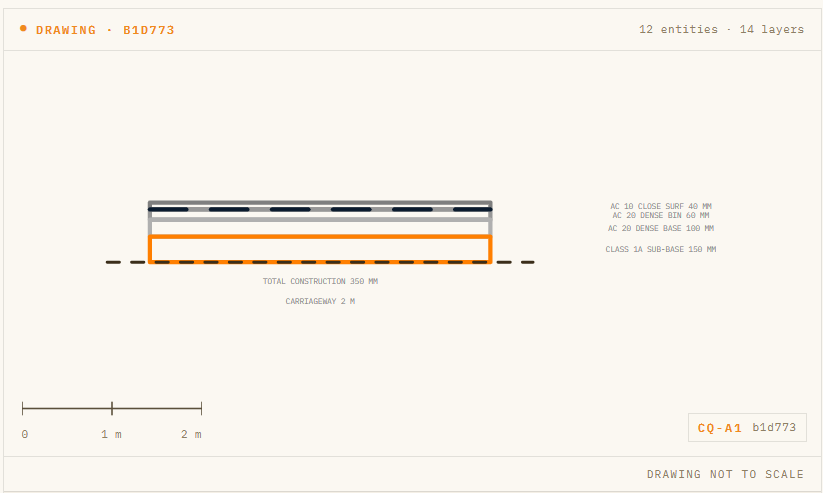
The footway build-up section (hash b1d773): surface, binder and base courses over the Type 1 sub-base, each layer labelled with its material and thickness.
| MMHW ref | Description | Quantity | Unit |
|---|---|---|---|
| 600.4 | Excavation of acceptable material for re-use as fill (SHW Cl. 605) | 35 | m³ |
| 600.5 | Disposal of unacceptable material off-site (SHW Cl. 605) | 35 | m³ |
| 600.16 | Formation preparation including compaction (SHW Cl. 616) | 100 | m² |
| 800.1 | Granular sub-base, Class 1A (SHW Cl. 803) | 15 | m³ |
| 700.1 | Dense asphalt concrete base, AC 20 dense base, 100 mm compacted (SHW Cl. 903) | 100 | m² |
| 700.5 | Dense asphalt concrete binder course, AC 20 dense bin, 60 mm compacted (SHW Cl. 906) | 100 | m² |
| 700.9 | Tack coat, cationic bitumen emulsion C40B4, 0.35 kg/m² (SHW Cl. 920) | 100 | m² |
| 700.7 | Close-graded asphalt concrete surface course, AC 10 close surf, 40 mm compacted (SHW Cl. 912) | 100 | m² |
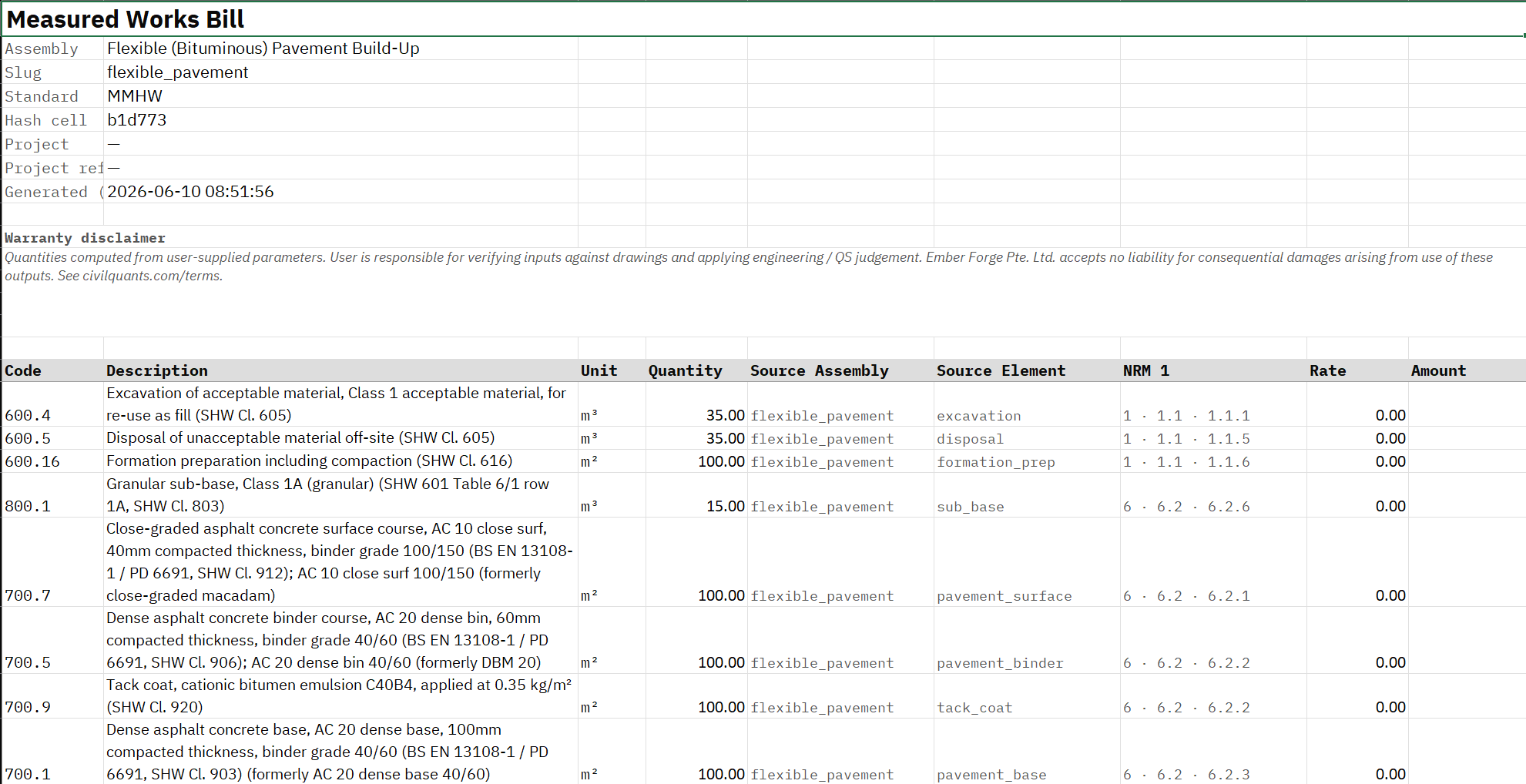
The same compute exported to Excel (hash b1d773 matches the drawing): the area rows at 100 m², the sub-base volume and the balancing excavation.
The shape of the bill is the lesson. The surfacing is three area items at 100 m² each (base, binder, surface) plus the tack coat at the same area; the sub-base is a volume (15 m³, which is 100 m² at 150 mm); and the excavation balances the build-up depth (35 m³, which is 100 m² at the full 350 mm build-up). Change the surfacing specification, a flag or block surface instead of asphalt, and the area rows change material but not their measurement basis. The carriageway version of this same build-up, with its heavier layers, is covered in measuring the carriageway pavement layers.
Edgings and the kerb interface: measured linearly
A footway needs an edge restraint, or it spreads and fails. That restraint is a linear item: precast edging or kerb on a concrete bed with a haunch. Below is 50 m of EF edging (one edge of the run; a footway restrained both sides doubles it) on a 150 mm concrete bed with a 50 mm bed margin each side, measured to MMHW from the same engine:
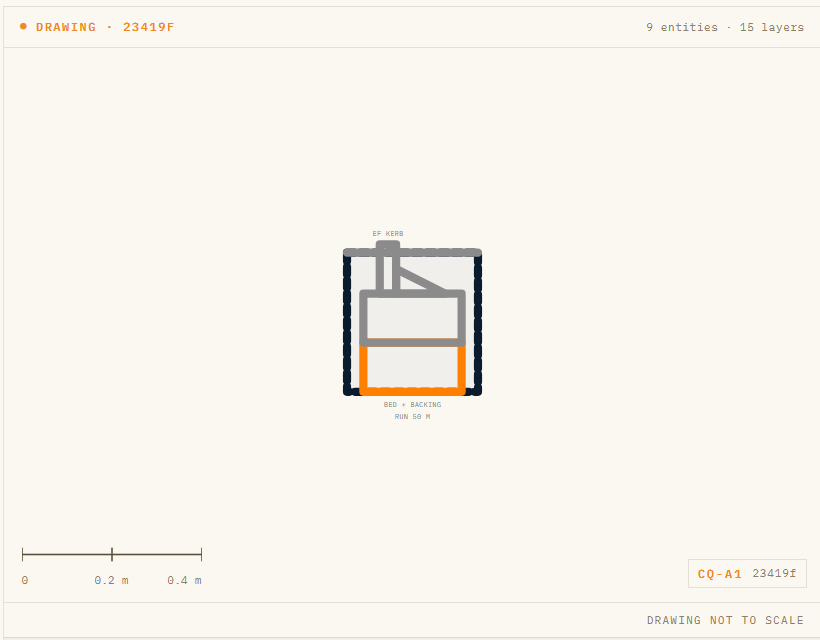
The EF edging section (hash 23419f): the edging unit on its concrete bed, with the haunch behind it holding the back face.
| MMHW ref | Description | Quantity | Unit |
|---|---|---|---|
| 600.6 | Excavation for structural foundations (SHW Cl. 607) | 8.50 | m³ |
| 600.5 | Disposal of unacceptable material off-site (SHW Cl. 605) | 5.16 | m³ |
| 600.8 | Site-won acceptable fill, Class 1 or 2 (SHW Cl. 608) | 3.34 | m³ |
| 800.1 | Granular sub-base, Class 1A (SHW Cl. 803) | 2.25 | m³ |
| 1700.3 | In-situ concrete, C20/25, kerb bed (SHW Cl. 1704) | 2.25 | m³ |
| 1700.3 | In-situ concrete, C20/25, kerb haunch (SHW Cl. 1704) | 0.28 | m³ |
| 1100.3 | Precast concrete edging, EF type, 50 by 150 mm, set on concrete bed (SHW Cl. 1101) | 50 | m |
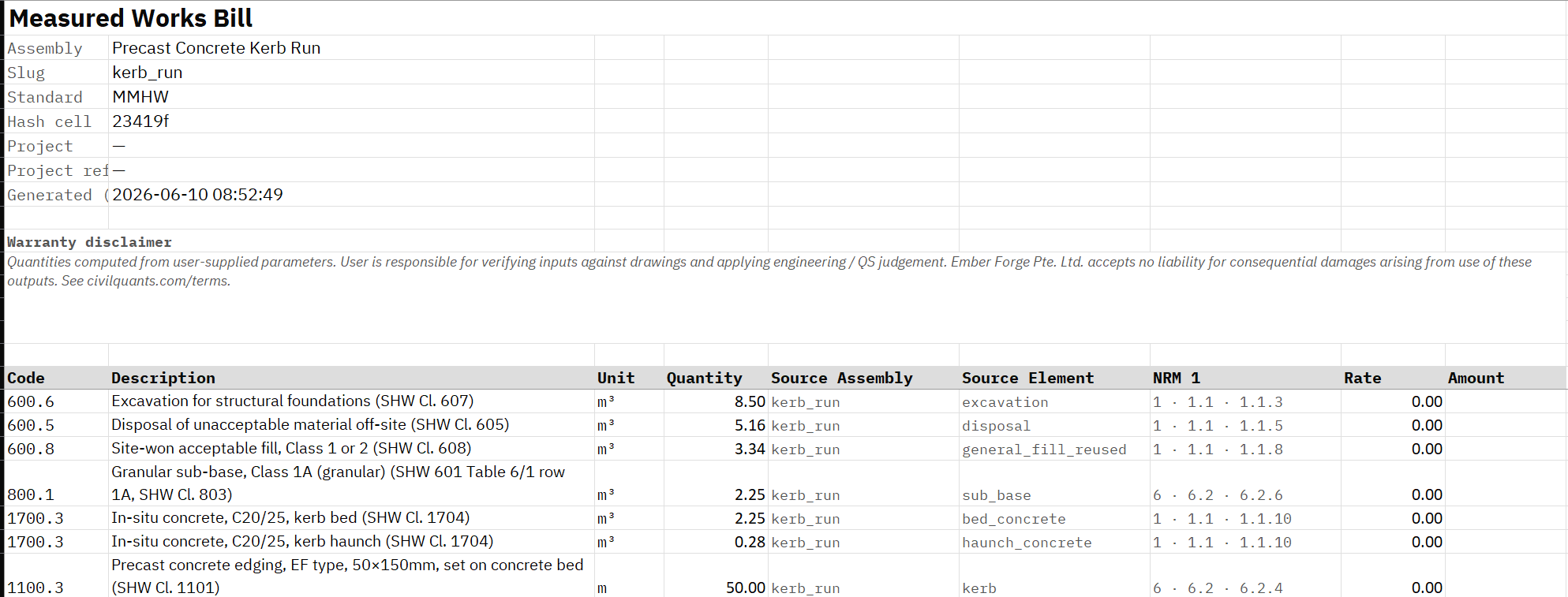
The edging bill (hash 23419f matches the section drawing): seven rows for one line of edging.
The edging is the 50 m line, but the concrete bed (2.25 m³) and haunch (0.28 m³) are what hold it, and they are separate rows, as are the dig, the disposal and the reused fill. Forget the bed and haunch and the edging is unpriced for the work that actually fixes it. For the full kerb and edging detail, including profiles and channel blocks, see measuring a kerb run.
Crossings: dropped kerbs and tactile paving
This is where footway bills most often fall short. At every crossing you need:
- Dropped kerbs, the transition units from full-height kerb down to flush. These are enumerated or measured as a short linear run of the dropped profile, plus their bed and haunch.
- Tactile paving, the blister surface at controlled and uncontrolled crossings (and corduroy at hazard locations such as the top of steps). This is measured by area, in the contrasting colour and pattern the crossing type requires.
- The transition kerbs either side of the dropped section, which estimators forget because they are not the dropped unit and not the run kerb.
An honest note on the engine: CivilQuants composes the footway build-up and the edging from its pavement and kerb assemblies, but the dropped-kerb and tactile-paving crossing items are enumerated additions you add per crossing; there is no single "footway with crossings" assembly. So a complete footway bill is the area build-up, plus the linear edging, plus an enumerated crossing pack at each location. We say so plainly because pretending one button measures a whole footway, crossings included, would be the kind of claim this blog exists to avoid.
Common errors
- Forgetting the tactiles. Blister and corduroy paving at crossings is a contrasting, separately specified surface, measured by area. It is easy to miss because it is a small quantity in an unfamiliar unit.
- Missing the dropped-kerb transitions. The transition kerbs either side of a dropped section are real units. Bill the dropped run and skip the transitions and the crossing is under-measured.
- Omitting the edge restraint. Surfacing without edging is incomplete. The edging, its bed and its haunch are linked items, not one.
- Surfacing measured as volume. Bound footway layers are area items at a stated thickness, not cubic metres. Mixing the basis double-counts or under-counts.
Doing it faster
A footway looks simple and bills long: area surfacing, a volume sub-base, linear edging, then a crossing pack at each location, with the excavation balancing the build-up depth. A parametric approach gives you the area build-up and the linear edging in seconds, each row with its derivation, leaving you to add the enumerated crossing items. The worked examples above are real engine output implementing MMHW methodology, and every number is reproducible by anyone with the same inputs. It is a tool for the estimator, not a replacement for one. The free tier renders MMHW for research and illustration; it is not warranted for tender or contract use.
FAQ
How is a footway measured in a BoQ? The bound surfacing by area at a stated compacted thickness, the excavation and sub-base by volume, the edge restraint linearly, and the crossings (dropped kerbs plus tactile paving) as enumerated items plus area.
Are tactile paving and dropped kerbs measured separately? Yes. Tactile paving is an area item in a contrasting surface; dropped kerbs are enumerated or measured as a short run of the dropped profile, with their own bed and haunch and the transition kerbs either side.
How is footway surfacing measured, area or volume? By area, in square metres, at a stated compacted thickness for each bound layer. The sub-base beneath it is measured by volume.
What edge restraint is measured? A precast edging or kerb on a concrete bed with a haunch, measured linearly, with the bed and haunch as separate concrete items.
Which items do estimators most often miss on a footway? Tactile paving at crossings, the dropped-kerb transition units, and the edging bed and haunch. All three are small quantities that are easy to drop.
Which standard applies to footway works? MMHW for highway footways (surfacing in Series 700, sub-base in Series 800, edgings in Series 1100, earthworks in Series 600); CESMM4 for general civil work, with the surfacing in the roads and pavings class.
Try it
Build a footway bill from its parts: the area build-up, the linear edging, then your crossing pack. Start a 7-day pass for £15, or try a free assembly to MMHW with no sign-up, then open the flexible pavement calculator.
Frequently asked questions
- How is a footway measured in a BoQ?
- The bound surfacing by area at a stated compacted thickness, the excavation and sub-base by volume, the edge restraint linearly, and the crossings (dropped kerbs plus tactile paving) as enumerated items plus area.
- Are tactile paving and dropped kerbs measured separately?
- Yes. Tactile paving is an area item in a contrasting surface; dropped kerbs are enumerated or measured as a short run of the dropped profile, with their own bed and haunch and the transition kerbs either side.
- How is footway surfacing measured, area or volume?
- By area, in square metres, at a stated compacted thickness for each bound layer. The sub-base beneath it is measured by volume.
- What edge restraint is measured?
- A precast edging or kerb on a concrete bed with a haunch, measured linearly, with the bed and haunch as separate concrete items.
- Which items do estimators most often miss on a footway?
- Tactile paving at crossings, the dropped-kerb transition units, and the edging bed and haunch. All three are small quantities that are easy to drop.
- Which standard applies to footway works?
- MMHW for highway footways (surfacing in Series 700, sub-base in Series 800, edgings in Series 1100, earthworks in Series 600); CESMM4 for general civil work, with the surfacing in the roads and pavings class.