How to Measure a Kerb Run in a BoQ (Bed, Haunch and All)
A kerb run is not just a length of kerb units. It is the precast kerb measured by the metre, plus the concrete bed it sits on, the haunch behind it, the granular sub-base under that, and the excavation and disposal to make room for the lot. Bill only the kerb units and you have left out most of the cost and all of the buildability. This post shows how to measure a kerb run properly under CESMM4, with a real worked example, and the item estimators most often under-measure.
For the wider document see a civil engineering Bill of Quantities; for the classification rules, see the step-by-step CESMM4 guide.
What a kerb run includes
Laying kerb is a small composite in its own right:
- Excavation of the kerb trench, and disposal of what cannot be reused
- Granular sub-base under the bed
- Concrete bed the kerb sits on
- Concrete haunch behind the back face that holds the kerb against traffic thrust
- The precast kerb units themselves, by the metre
- Optionally a channel block on the carriageway side
The kerb units are the obvious item. The bed and haunch concrete are the ones that get squeezed, and they are real volume.
Measuring it under CESMM4
The run below is 25 m of HB2 road kerb at the calculator default: a 150 mm concrete bed, a haunch to the back face, and 150 mm of Type 1 (Class 1A) sub-base, measured to CESMM4. The quantities are real CivilQuants engine output, generated for this article. Treat them as a modelled example for illustration, not a tender; every number is reproducible from the same geometry.
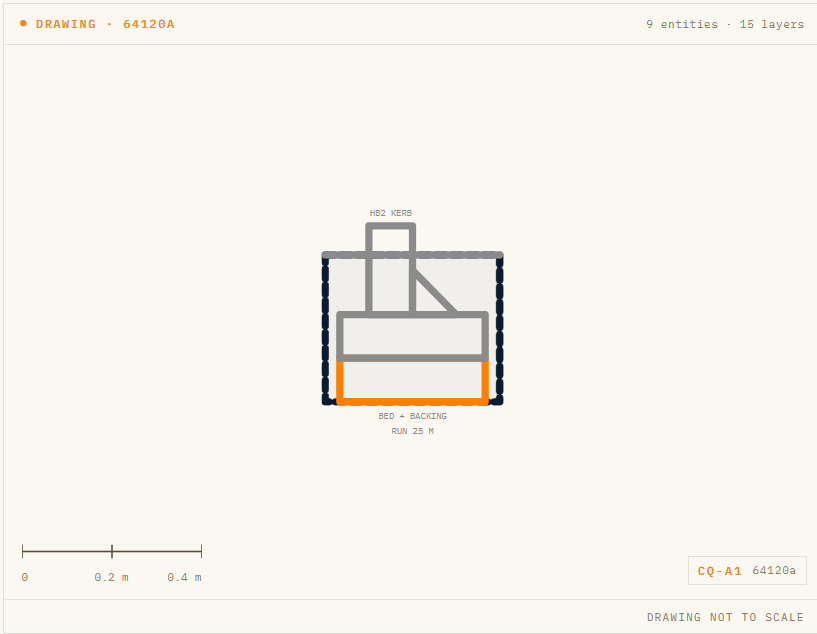
The kerb run section (hash 64120a): kerb on top, haunch to the back face, concrete bed, then the sub-base at the bottom of the trench.
| CESMM code | Description | Quantity | Unit |
|---|---|---|---|
| E.4.3.3 | Excavation for foundations, maximum depth 0.5 to 1 m | 7.58 | m³ |
| E.5.3 | Disposal of excavated material off-site | 5.18 | m³ |
| E.6.2.1 | Filling, excavated material (reused on site) | 2.40 | m³ |
| E.6.5.1 | Filling, imported sub-base, Class 1A granular | 1.88 | m³ |
| F.5.2.3 | In-situ concrete C20/25, kerb bed | 1.88 | m³ |
| F.5.2.3 | In-situ concrete C20/25, kerb haunch | 0.29 | m³ |
| R.7.1.1 | Precast concrete kerb, Type HB2, 150 by 305 mm, to BS EN 1340 / SHW Cl. 1101 | 25 | m |
The kerb is one line, 25 m. Everything else, the dig, the disposal, the reused and imported fill, and the two concrete pours, is the rest of the cost. The kerb description carries the type (HB2) and the standard reference, so the priced rate matches the actual unit.
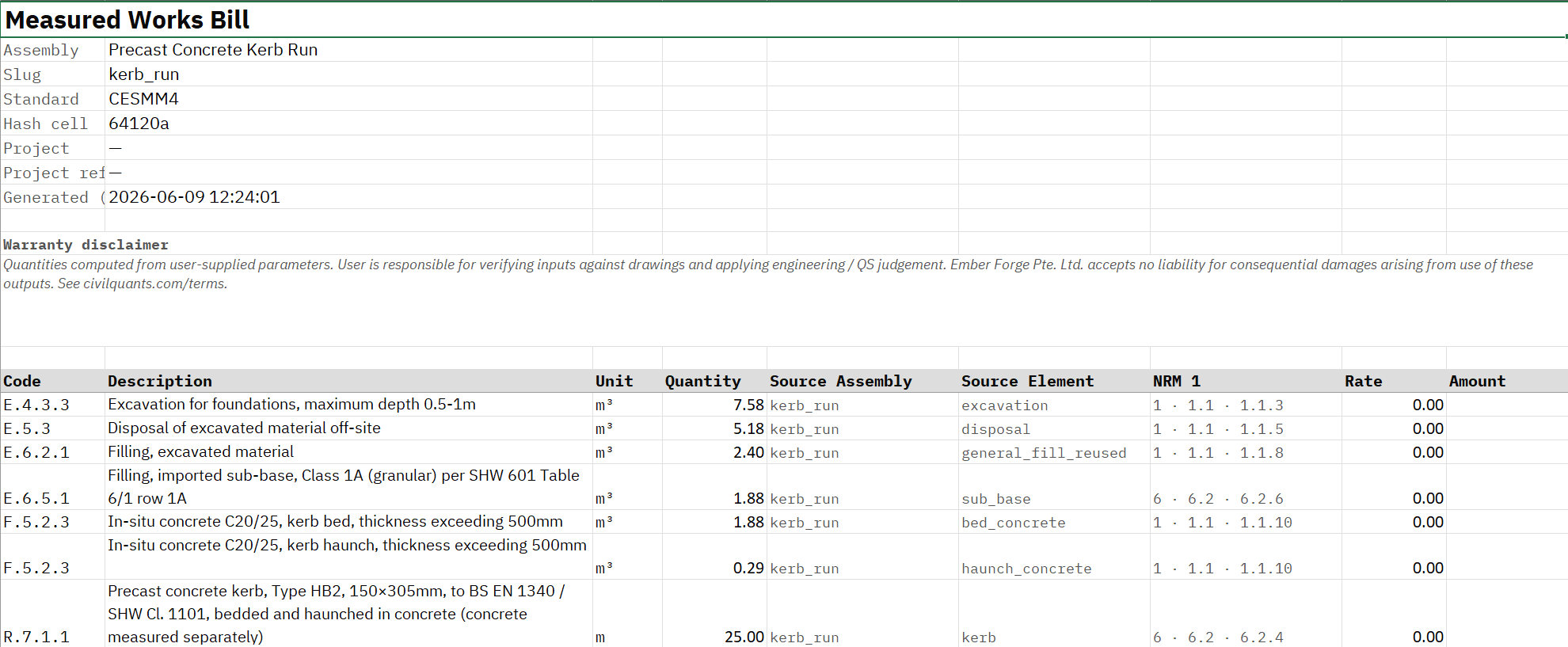
The CESMM4 bill (hash 64120a): the foundation excavation (E.4.3.3), bed and haunch concrete (F.5.2.3), and the kerb units (R.7.1.1), measured as separate items.
The bedding and haunch concrete
This is the volume that gets lost. Across the 25 m default run there is 1.88 m³ of bed and 0.29 m³ of haunch, 2.17 m³ of concrete in total, and it is measured separately from the kerb units because it is a different operation priced a different way. An estimator who bills the kerb by the metre and folds a notional bedding allowance into that rate has hidden 2.17 m³ of concrete and made the bill harder to check. Scale the run to 100 m and that is roughly 8.7 m³ of concrete hidden in a per-metre rate. CESMM keeps the kerb and its concrete apart for exactly that reason. The same discipline applies when you measure the carriageway pavement layers the kerb edges.
Kerb types and channels
The kerb type drives the unit and the haunch. HB2 is the standard half-battered road kerb; SP, BN, EF and ER cover splay, bullnose and edging profiles, each with its own cross-section. A channel block on the carriageway side adds a separate line. Pick the type from the drawings, because the type sets both the kerb rate and the bedding geometry, and a generic "kerb, 25 m" tells a pricing estimator nothing.
Common errors
- Billing only the kerb units. The bed, haunch, sub-base, excavation and disposal are most of the cost. Measure them.
- Folding the bedding into the kerb rate. It hides the concrete and breaks comparability.
- Forgetting the haunch. Small per metre, real over a run, and load-bearing against traffic.
- Wrong kerb type. HB2 priced as edging, or the reverse, misprices the unit and the bedding both.
FAQ
How is kerb measured in a Bill of Quantities? The kerb units are measured by the linear metre; the concrete bed and haunch by volume; the sub-base, excavation and disposal each as their own items. The kerb type and standard reference go in the description.
Is the bedding concrete included in the kerb rate? Not under CESMM. The bed and haunch are measured separately by volume, so the cost is visible and checkable rather than buried in the per-metre kerb rate.
What is the haunch on a kerb? The wedge of concrete behind the back face that resists traffic thrust and holds the kerb in line. It is measured as concrete, separately from the bed.
What kerb types are there? Common UK precast profiles include HB2 and HB1 half-battered road kerbs, splay, bullnose, and edging kerbs, each to BS EN 1340 and the SHW kerb clauses.
Do I measure a channel separately? Yes. A channel block on the carriageway side is a separate item from the kerb.
Which CESMM4 classes does a kerb run use? Class E for excavation, disposal and sub-base, Class F for the bed and haunch concrete, and Class R for the kerb units.
Try it
Measure a kerb run from its length and section and read the full bill. Start a 7-day pass for £15, or try a free assembly to MMHW with no sign-up, then open the kerb run calculator.
Frequently asked questions
- How is kerb measured in a Bill of Quantities?
- The kerb units are measured by the linear metre; the concrete bed and haunch by volume; the sub-base, excavation and disposal each as their own items. The kerb type and standard reference go in the description.
- Is the bedding concrete included in the kerb rate?
- Not under CESMM. The bed and haunch are measured separately by volume, so the cost is visible and checkable rather than buried in the per-metre kerb rate.
- What is the haunch on a kerb?
- The wedge of concrete behind the back face that resists traffic thrust and holds the kerb in line. It is measured as concrete, separately from the bed.
- What kerb types are there?
- Common UK precast profiles include HB2 and HB1 half-battered road kerbs, splay, bullnose, and edging kerbs, each to BS EN 1340 and the SHW kerb clauses.
- Do I measure a channel separately?
- Yes. A channel block on the carriageway side is a separate item from the kerb.
- Which CESMM4 classes does a kerb run use?
- Class E for excavation, disposal and sub-base, Class F for the bed and haunch concrete, and Class R for the kerb units.