How to Measure Carriageway Pavement Layers in a BoQ
A flexible carriageway pavement is a build-up of layers, and each layer is its own measured item. From the bottom: a prepared formation, a granular sub-base, an asphalt base, a binder course, a tack coat, and a surface course. The bound layers are measured by area at a stated compacted thickness, the sub-base by volume, and the excavation and disposal sit underneath it all. This post shows how to measure a carriageway pavement under CESMM4 with a real worked example, and explains the one convention that trips people up: why the asphalt is measured by area, not volume.
For the wider document see a civil engineering Bill of Quantities; for the classification rules, see the step-by-step CESMM4 guide.
The pavement build-up
A medium-traffic urban pavement is a stack of layers, each with a job:
- Formation, the prepared subgrade surface the pavement is built on
- Sub-base, granular Type 1, spreading the load to the subgrade
- Base (asphalt concrete), the main structural layer
- Binder course, between base and surface
- Tack coat, the bond between bound layers
- Surface course, the wearing layer that takes traffic and weather
Each is specified by material and thickness, and each is a separate BoQ line, because each is a different material laid in a different operation.
Measuring it under CESMM4
The pavement below is 100 m by 6 m of medium-traffic flexible carriageway at the calculator default: 150 mm Type 1 (Class 1A) sub-base, 150 mm AC 32 dense base, 60 mm AC 20 dense binder, a tack coat, and a 40 mm SMA 10 surface course, measured to CESMM4. The quantities are real CivilQuants engine output, generated for this article. Treat them as a modelled example for illustration, not a tender; every number is reproducible from the same geometry.
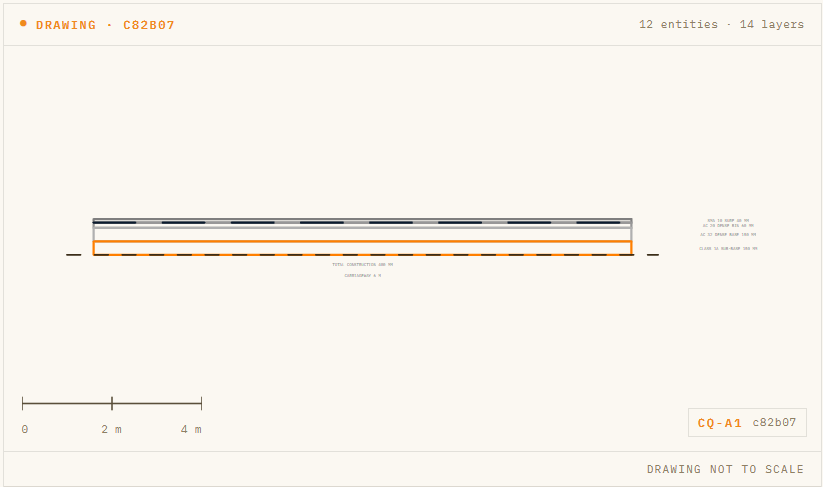
The pavement build-up (hash c82b07): SMA 10 surface course, AC 20 dense binder, AC 32 dense base and the Class 1A sub-base, drawn to scale and labelled layer by layer.
| CESMM code | Description | Quantity | Unit |
|---|---|---|---|
| E.4.2.2 | General excavation, maximum depth 0.25 to 0.5 m | 240 | m³ |
| E.5.3 | Disposal of excavated material off-site | 240 | m³ |
| E.7.1 | Preparation of formation | 600 | m² |
| E.6.5.1 | Filling, imported sub-base, Class 1A granular, 150 mm | 90 | m³ |
| R.2.1 | Asphalt concrete base, AC 32 dense base, 150 mm compacted | 600 | m² |
| R.3.1 | Asphalt concrete binder course, AC 20 dense bin, 60 mm compacted | 600 | m² |
| R.3.7 | Tack coat, cationic bitumen emulsion, 0.35 kg/m² | 600 | m² |
| R.3.5 | Stone mastic asphalt surface course, SMA 10, 40 mm compacted | 600 | m² |
The 600 m² is the carriageway area (100 by 6). Each bound layer carries that same 600 m² because it covers the whole carriageway; what distinguishes them is the material and the compacted thickness in the description. The dig is 240 m³ (the full 0.4 m build-up over the formation) and the sub-base is the only granular fill, 90 m³.
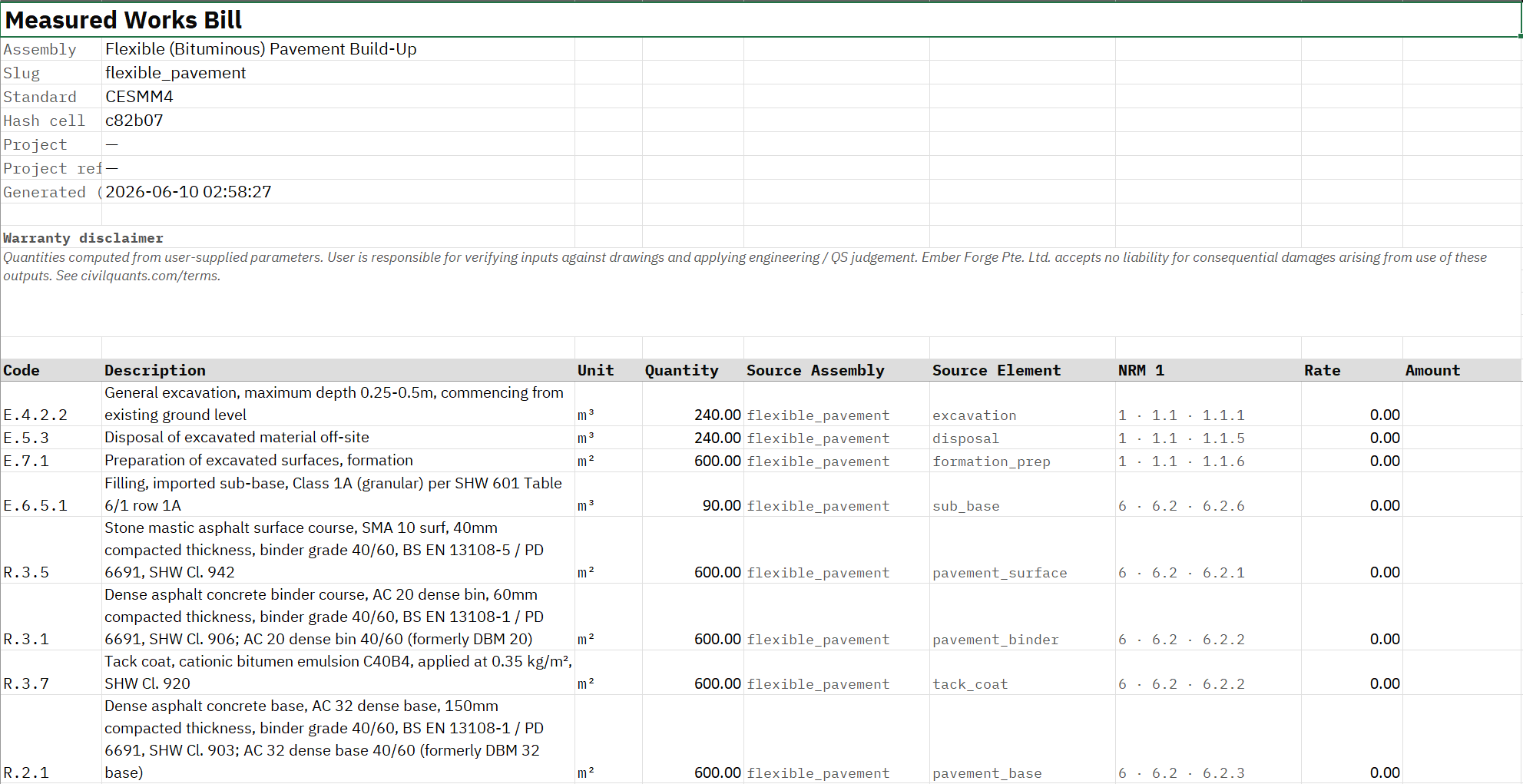
The CESMM4 bill (hash c82b07): the 240 m³ dig and 600 m² formation in Class E, the 90 m³ sub-base, and the four bound layers at 600 m² each in Class R.
Why the asphalt is measured by area, not volume
This is the convention that catches people. The bound layers, base, binder and surface, are measured by area at a stated thickness (600 m² of AC 32 base, 150 mm thick), not by volume. The thickness lives in the description, not the quantity. The sub-base, by contrast, is measured by volume (90 m³). Mix the two up, bill the asphalt by volume or the sub-base by area, and the bill stops matching how the work is priced and laid. The tack coat is measured by area too, because it is an application rate over a surface, not a thickness.
Capping and traffic category
Two things drive the build-up. The traffic category (domestic, light, medium, heavy) sets the layer thicknesses and materials; this example is medium. On a weak subgrade you also add a capping layer below the sub-base, which is a further measured item. For design traffic above the parametric range, a full pavement design to DMRB CD 226 is needed, and the build-up is specified rather than defaulted. The earthworks that form the subgrade are measured separately; see measuring earthworks. The same layer-by-layer discipline applies where the carriageway meets its edge; see measuring a kerb run.
Common errors
- Measuring asphalt by volume. Bound layers are area at a stated thickness. The thickness is in the description.
- Forgetting the formation preparation. The prepared formation is a measured area item, not free.
- Dropping the tack coat. It is a real applied item between bound layers.
- One generic "pavement" line. Each layer is a different material and operation; bill them separately or the rate means nothing.
FAQ
How is a road pavement measured in a BoQ? Layer by layer. The bound asphalt layers by area at a stated compacted thickness, the granular sub-base by volume, the formation preparation by area, and the excavation and disposal underneath.
Why is asphalt measured by area and not volume? Because it is laid and priced as a layer of stated thickness over an area. The thickness goes in the description; the quantity is the area covered.
What layers are in a flexible pavement? Typically a prepared formation, a granular sub-base, an asphalt base, a binder course with a tack coat, and a surface course. Material and thickness vary with traffic.
What is a capping layer? A coarse granular layer placed below the sub-base on a weak subgrade to provide a working platform and spread load. It is a separate measured item.
What sets the pavement thicknesses? The design traffic (msa) and subgrade strength, per DMRB CD 226. Coarse categories (domestic to heavy) give starting build-ups; heavy or weak-subgrade cases need a full design.
Which CESMM4 classes does a pavement use? Class E for excavation, disposal, formation and sub-base, and Class R for the bound pavement layers.
Try it
Build a pavement from its dimensions and traffic category and read the layer-by-layer bill. Start a 7-day pass for £15, or try a free assembly to MMHW with no sign-up, then open the flexible pavement calculator.
Frequently asked questions
- How is a road pavement measured in a BoQ?
- Layer by layer. The bound asphalt layers by area at a stated compacted thickness, the granular sub-base by volume, the formation preparation by area, and the excavation and disposal underneath.
- Why is asphalt measured by area and not volume?
- Because it is laid and priced as a layer of stated thickness over an area. The thickness goes in the description; the quantity is the area covered.
- What layers are in a flexible pavement?
- Typically a prepared formation, a granular sub-base, an asphalt base, a binder course with a tack coat, and a surface course. Material and thickness vary with traffic.
- What is a capping layer?
- A coarse granular layer placed below the sub-base on a weak subgrade to provide a working platform and spread load. It is a separate measured item.
- What sets the pavement thicknesses?
- The design traffic (msa) and subgrade strength, per DMRB CD 226. Coarse categories (domestic to heavy) give starting build-ups; heavy or weak-subgrade cases need a full design.
- Which CESMM4 classes does a pavement use?
- Class E for excavation, disposal, formation and sub-base, and Class R for the bound pavement layers.