Sign Posts, Barriers and Highway Furniture: BoQ Measurement Made Simple
Highway furniture is measured on two different bases at once. Signs, posts and lighting columns are enumerated, by number, with their foundations; safety barriers and road markings are linear, by the metre. Each item then splits into supply and install, and a surprising amount of the work is deemed included in the unit rate rather than measured separately. Get the enumerated-versus-linear split right, remember the foundations and the barrier terminals, and the rest follows. This post walks the main item types under MMHW, with reproducible worked examples.
For the wider document see a civil engineering Bill of Quantities; for how MMHW structures a highway item, see the MMHW guide; for the kerbline these items sit behind, see how to measure a kerb run.
Enumerated items: signs, posts and columns
A traffic sign is counted, not billed by area. The face area drives the rate band, but the bill quantity is enumerated. The sign comes apart into three lines: the post, the face, and the foundation. Below is the calculator default, a single warning triangle (the standard red-bordered hazard sign) on a 3 m galvanised steel post in a verge, measured to MMHW. The quantities are real CivilQuants engine output, generated for this article. Treat them as a modelled example for illustration, not a tender; every number is reproducible from the same inputs. Signs, barriers and markings are paid-tier assemblies in CivilQuants; MMHW is the standard the free tier renders on its six free assemblies.
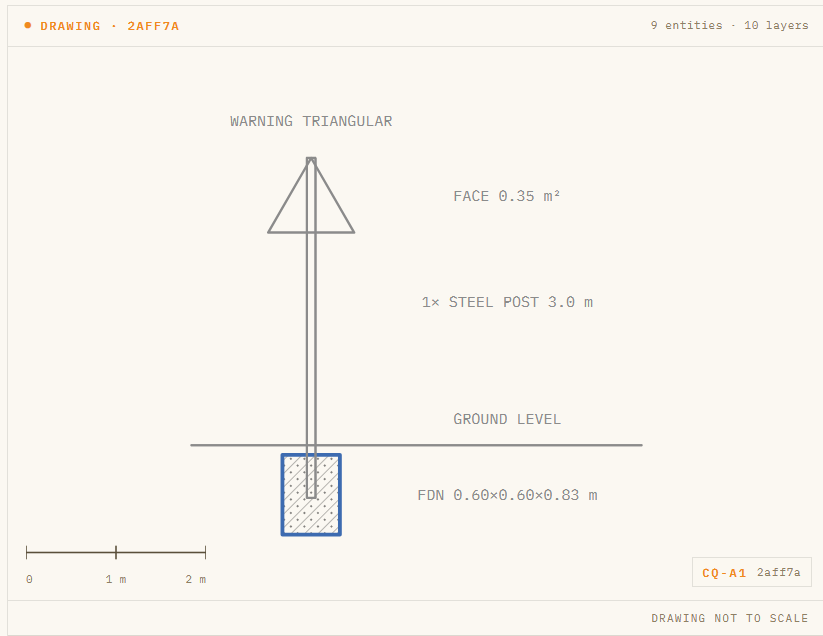
The sign elevation (hash 2aff7a): the 0.35 m² warning face on its 3 m post, with the 0.60 by 0.60 by 0.83 m foundation below the ground line.
| MMHW ref | Description | Quantity | Unit |
|---|---|---|---|
| 1300.1.1.1 | Traffic sign post, warning sign (triangular) per TSRGD 2016 Schedule 2, galvanised steel, face area class small, post-mounted (SHW Cl. 1201) | 3 | m |
| 1300.2.1 | Traffic sign face, warning triangular per TSRGD 2016, RA2 retroreflective sheeting, approx 0.35 m² (small class) | 1 | nr |
| 1300.3 | Sign foundation per SHW Cl. 1204, post mounted small type, concrete C25/30 deemed included, approx 0.30 m³ | 1 | nr |
Three things to read here. The post is measured by length, 3 m of steel post, banded by face area and mounting height together (that is what the third and fourth digits of 1300.1.1.1 are doing). The face is enumerated, 1 nr, with the actual area of 0.35 m² carried in the description to set the rate band. And the foundation is a separate enumerated item, not a forgotten extra. Note the honest detail in the foundation row: under SHW Cl. 1204 the concrete is deemed included in the foundation unit rate, so there is no separate concrete line. That is correct UK practice, and it catches people who expect to bill the 0.30 m³ of concrete on its own.
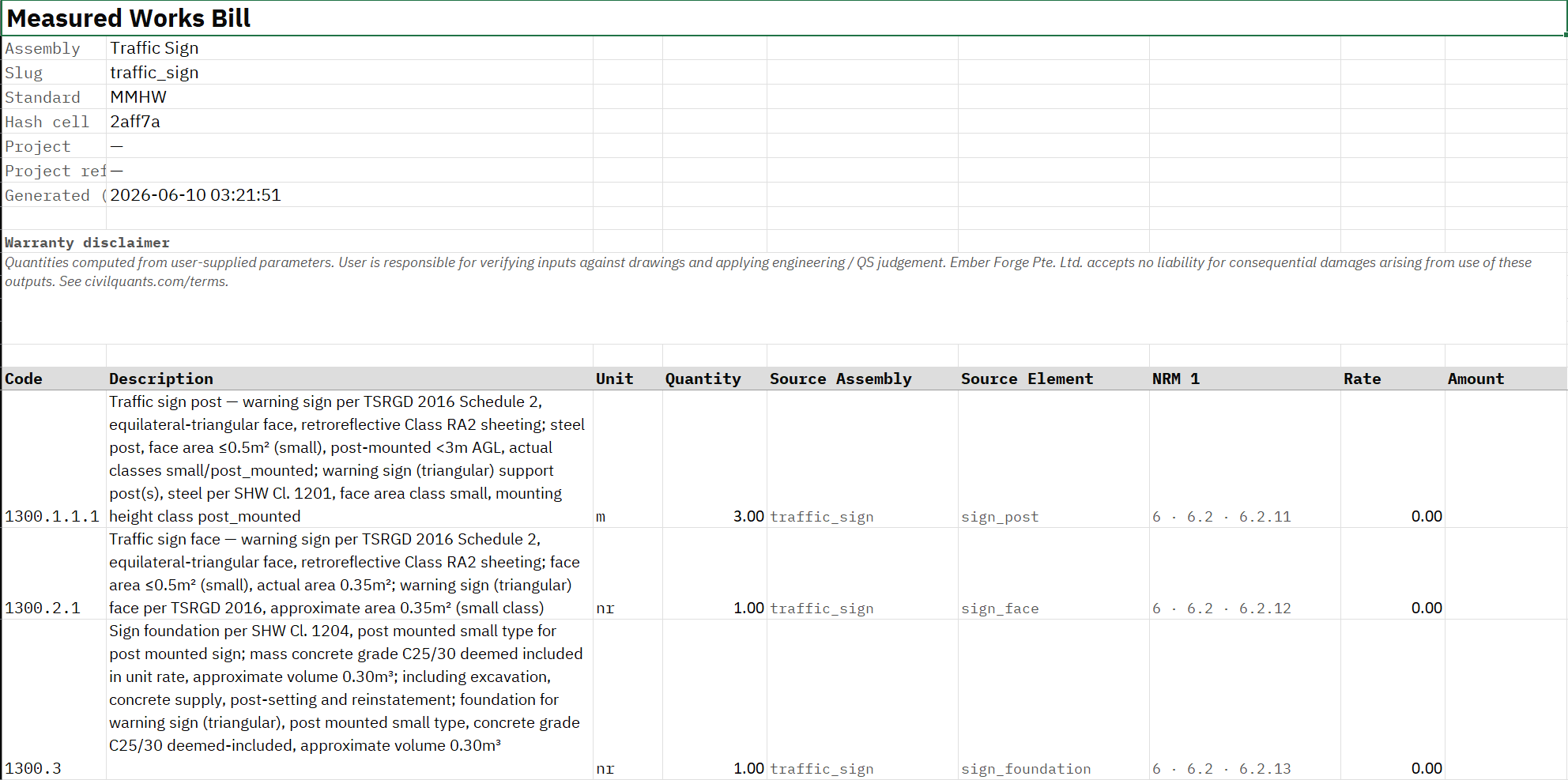
The MMHW bill (hash 2aff7a): the post by the metre, the face and the foundation enumerated, with the foundation concrete deemed included in the unit rate.
The same logic runs through lighting columns. At the calculator default a 6 m galvanised steel column splits into three lines: the column shaft by the metre (6 m), the precast socket foundation enumerated (1 nr, with its excavation, base concrete and earth rod deemed included), and the LED luminaire enumerated (1 nr). Count the unit, measure its support by length, and bill the foundation as its own item.
Linear items: barriers and road markings
A safety barrier is a linear item. Below is the calculator default, 100 m of tensioned corrugated-beam vehicle restraint system (the standard W-beam verge barrier) on driven posts, working width W4, containment N2, measured to MMHW:
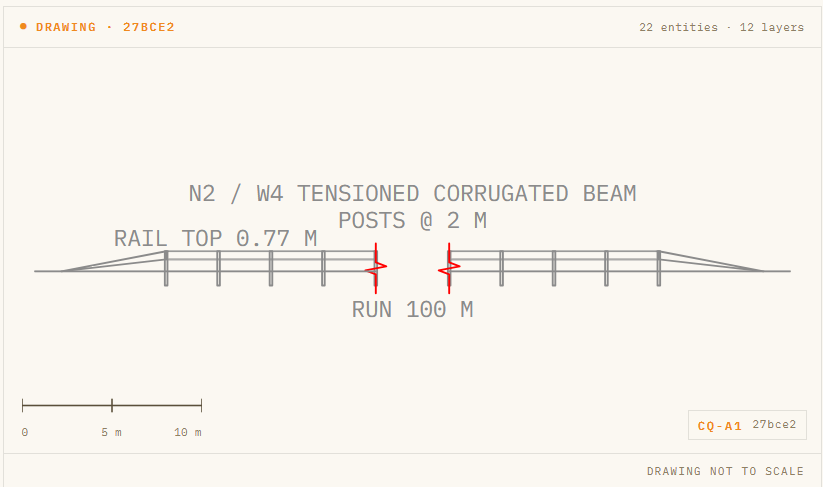
The barrier elevation (hash 27bce2): the end bays of the N2 W4 run drawn at true scale with break marks standing in for the middle, posts at 2 m centres, rail top at 0.77 m, run 100 m.
| MMHW ref | Description | Quantity | Unit |
|---|---|---|---|
| 400.1.2.1 | Vehicle restraint system, tensioned corrugated steel beam, working width W4, containment N2 (SHW Cl. 402, BS EN 1317-2) | 100 | m |
| 400.2.2 | Vehicle restraint system terminal, performance class P2 (SHW Cl. 408, BS EN 1317-4) | 2 | nr |
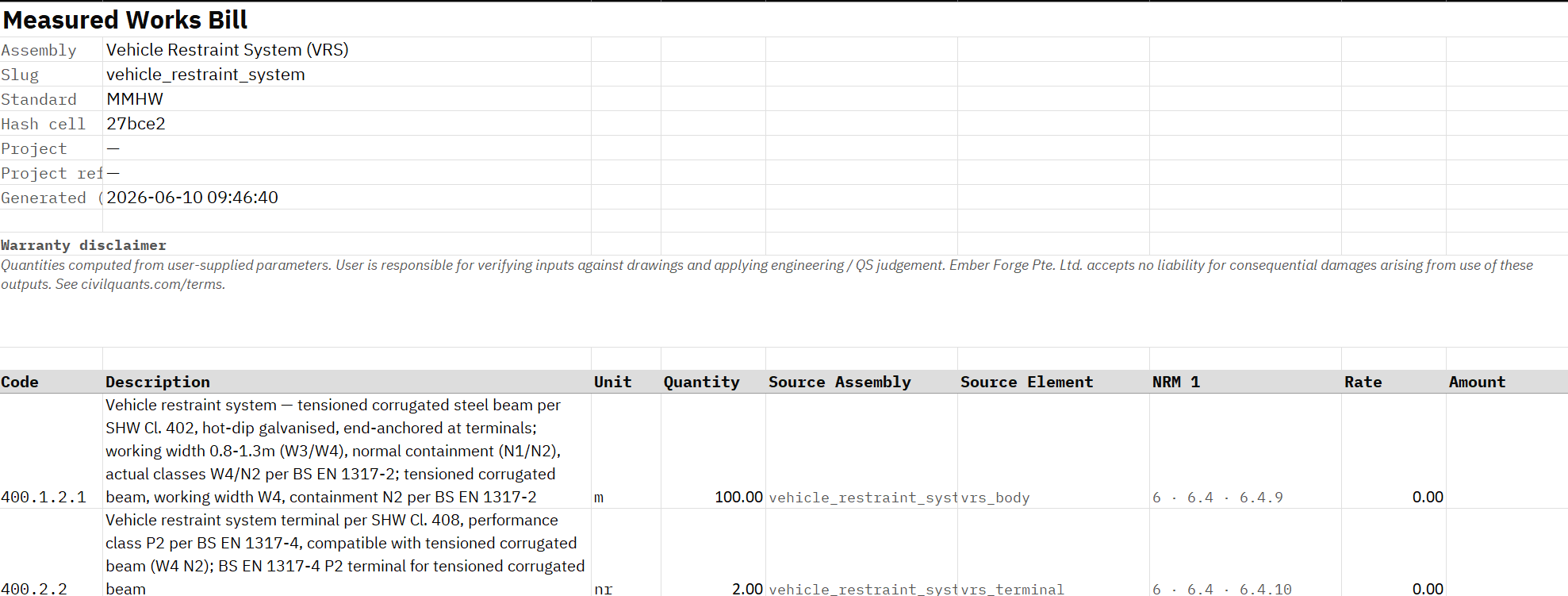
The barrier bill (hash 27bce2 matches the elevation): the linear beam row banded by working width and containment, and the terminals enumerated separately.
The barrier itself is the 100 m line, but look at the second row: the two terminals are a separate, enumerated item. A barrier with no terminals is not a barrier, and forgetting the end anchorages (and any transitions to a parapet) is the single most common highway-furniture error. Note too that MMHW Series 400 bands the barrier by both working width and containment level at once: move from the W3/W4 band to W2, or from normal containment to H2, and the code changes with the rate. The classification is doing real pricing work, not decoration. Note also what is absent: with driven posts, the default here, there is no excavation or foundation row at all. The post driving is deemed included in the linear rate, which is exactly the kind of thing the standard decides for you.
Road markings are linear too, but with the widest unit mix of any item. The line below is the calculator default, 200 m of continuous 100 mm thermoplastic line:
| MMHW ref | Description | Quantity | Unit |
|---|---|---|---|
| 1200.1.1 | Road marking line, continuous, 100 mm wide, thermoplastic (SHW Cl. 1208, TSRGD 2016 Schedule 6) | 200 | m |
A full marking package adds painted areas by the square metre (hatched chevrons, ghost islands, box junctions), symbols by number (arrows, give-way triangles, words), and reflective studs by number. So a road-marking bill can carry metres, square metres and numbers in the same assembly. The line is banded by width class, because material coverage and the contractor's rate both scale with width, and the surface preparation and traffic management for application are deemed included in the rate.
Supply versus install, and what is deemed included
Two questions decide how a furniture item reads on the bill:
- Where does the supply-install line sit? For most highway furniture the unit rate is supply-and-install combined. But statutory items, a lighting column energised by the DNO or a chamber supplied by a utility, often split into a Prime Cost supply sum plus a contractor attendance line.
- What is deemed included? Sign-foundation concrete (SHW Cl. 1204), the driving of a barrier post, the preparation under a marking: a lot of incidental work is bundled into the headline unit rate by the standard. Billing it again double-counts. The standard tells you what is included, and reading that note is the difference between a clean bill and a padded one.
For how MMHW structures any one of these items, the Series reference, the SHW clause, the description, see how MMHW structures a highway item.
Common errors
- Forgetting the foundations and bases. Every post and column needs a foundation, billed as its own enumerated item. The concrete may be deemed included, but the foundation line is not.
- Mixing supply and install. Putting a supply-only PC sum where a supply-and-install rate belongs, or the reverse, misprices the item and confuses the priced bill.
- Dropping barrier terminals and transitions. The end anchorages and any transition to a parapet are separate enumerated items. A barrier line with no terminals is incomplete.
- Wrong band on the barrier. Series 400 bands by working width and containment together. Bill a W4 N2 barrier in the wrong band and the rate is wrong.
- Billing deemed-included work as a separate line. Sign-foundation concrete or driven-post installation billed again is a double count.
Doing it faster
Highway furniture bills are fiddly because the measurement basis changes item by item: a sign is enumerated with a banded post and a deemed-concrete foundation, a barrier is linear with enumerated terminals and a two-axis band, a marking is metres plus areas plus numbers. A parametric approach holds those rules for you: pick the sign type or barrier class, state the run length, and the engine returns the right lines on the right bases with the foundation and terminals included. The examples above are real engine output, reproducible from the same inputs, measured in accordance with MMHW. It is a tool for the estimator, not a replacement for one, and it measures the furniture assemblies you give it, not a complete project bill.
FAQ
How is highway furniture measured in a BoQ? On two bases. Signs, posts and lighting columns are enumerated (by number) with their foundations; safety barriers and road markings are linear (by metre). Each item splits into supply and install.
Are signs measured by number or by area? The bill quantity is enumerated (by number). The face area sets the rate band and the material cost, but you count the sign, you do not bill it by the square metre.
How are safety barriers measured? Linearly, by metre of barrier, with the terminals (and any transitions) as separate enumerated items. MMHW bands the barrier by working width and containment level together.
Is the foundation or base measured separately? The foundation is a separate enumerated item, but the concrete in a sign foundation is usually deemed included in that unit rate (SHW Cl. 1204), so it is not billed as a separate concrete line.
How are road markings measured? Lines by metre (banded by width), painted areas by square metre, and symbols and reflective studs by number. A single marking package can carry all four units.
What is the supply-versus-install split? Most furniture is a combined supply-and-install rate. Statutory or utility-supplied items split into a Prime Cost supply sum plus a contractor attendance line.
How are lighting columns measured? Like signs: the column shaft by length, the foundation as an enumerated item with its incidental work deemed included, and the luminaire as a separate enumerated item.
Try it
Measure signs, barriers and markings consistently. Start a 7-day pass for £15, or try a free assembly to MMHW with no sign-up, then open the vehicle restraint system calculator.
Frequently asked questions
- How is highway furniture measured in a BoQ?
- On two bases. Signs, posts and lighting columns are enumerated (by number) with their foundations; safety barriers and road markings are linear (by metre). Each item splits into supply and install.
- Are signs measured by number or by area?
- The bill quantity is enumerated (by number). The face area sets the rate band and the material cost, but you count the sign, you do not bill it by the square metre.
- How are safety barriers measured?
- Linearly, by metre of barrier, with the terminals (and any transitions) as separate enumerated items. MMHW bands the barrier by working width and containment level together.
- Is the foundation or base measured separately?
- The foundation is a separate enumerated item, but the concrete in a sign foundation is usually deemed included in that unit rate (SHW Cl. 1204), so it is not billed as a separate concrete line.
- How are road markings measured?
- Lines by metre (banded by width), painted areas by square metre, and symbols and reflective studs by number. A single marking package can carry all four units.
- What is the supply-versus-install split?
- Most furniture is a combined supply-and-install rate. Statutory or utility-supplied items split into a Prime Cost supply sum plus a contractor attendance line.
- How are lighting columns measured?
- Like signs: the column shaft by length, the foundation as an enumerated item with its incidental work deemed included, and the luminaire as a separate enumerated item.