CESMM4 Bill of Quantities: A Step-by-Step Guide with Worked Examples
A CESMM4 Bill of Quantities classifies every item of civil work into one of 26 work classes (A to Z), builds each item description from CESMM's three-part descriptive structure, measures the quantity to that class's rules, and keeps method-related charges separate from measured work. Get those four things right and your bill is consistent, auditable, and reads the same way to every estimator who prices it. This guide walks each step and ends with a real worked example, a cantilever retaining wall, that you can reproduce yourself.
If you are new to the document itself, start with what a civil engineering Bill of Quantities is and come back. Everything below assumes you already know what a BoQ is for.
What CESMM4 is and where it applies
CESMM4 is the fourth edition of the Civil Engineering Standard Method of Measurement, published by the Institution of Civil Engineers through Thomas Telford. It is the default method of measurement for civil engineering works in the UK, and it pairs naturally with the ICE Conditions and the NEC family of contracts. Where a building surveyor reaches for NRM2, a civils QS reaches for CESMM4.
The point of a standard method is not bureaucracy. It is that two estimators, given the same drawings, should produce bills that can be compared line for line. CESMM4 achieves that by fixing how work is classified, how each item is described, and what is and is not included in a measured rate.
The 26 work classes (A to Z)
CESMM4 sorts all civil work into 26 classes. You do not need every class on every job, but you do need to know which class a given item belongs in, because the class sets the measurement rules and the unit.
The classes that carry most civils bills are:
- Class E, Earthworks: excavation, disposal, filling, landscaping.
- Class F, In-situ concrete, and Class G, Concrete ancillaries: the concrete itself, then formwork, reinforcement, joints and finishes.
- Class I to L, Pipework: pipes, fittings and valves, manholes and pipework ancillaries, supports and protection.
- Class K specifically covers manholes and pipework ancillaries.
- Class R, Roads and pavings, and Class P/Q, Piling, round out most highway and structures work.
For the full list and how the lettering maps to real items, see the 26 CESMM4 work classes.
How a CESMM item description is built
This is the part that makes CESMM bills consistent and, increasingly, machine-readable. Every item description is assembled from three divisions of classification. The first division sets the broad type of work, the second narrows it, and the third pins the specific dimension or property that drives the rate. The result is a coded description where each part means something fixed.
Take general excavation between 2 m and 5 m deep. The class is E, the first division identifies general excavation, and the depth band 2 m to 5 m is the third-division classification that separates it from shallower or deeper digging, which carry different rates. Code it once that way and any estimator pricing the bill knows exactly what they are pricing, with no ambiguity about depth.
Method-related charges versus measured work
CESMM does something most building methods do not: it separates method-related charges from measured work. Measured work is quantity that scales with the design, a cubic metre of concrete, a tonne of rebar. A method-related charge is a cost tied to how the contractor chooses to do the work rather than to the quantity, for example bringing a piling rig to site, or the standing cost of dewatering.
Keeping the two apart matters for civils costing because so much civil work is method-driven. Burying those costs inside measured rates hides them and makes the bill harder to compare. CESMM's honest split is one of the reasons it suits civil engineering better than methods written for buildings. If you want that comparison in full, read CESMM4 against NRM2.
Step-by-step: preparing a BoQ for a cantilever retaining wall
A cantilever retaining wall is a good teaching example because it is not one line. It is a composite of measured items spread across several work classes, which is exactly where CESMM's classification earns its keep.
The wall below is an in-situ reinforced concrete cantilever wall, 4.0 m stem, 25 m long, measured to CESMM4. The quantities are real output from the CivilQuants engine, generated from the calculator's default geometry. Treat them as a modelled example for illustration, not a tender, but every number is reproducible: enter the same geometry and you get the same bill.
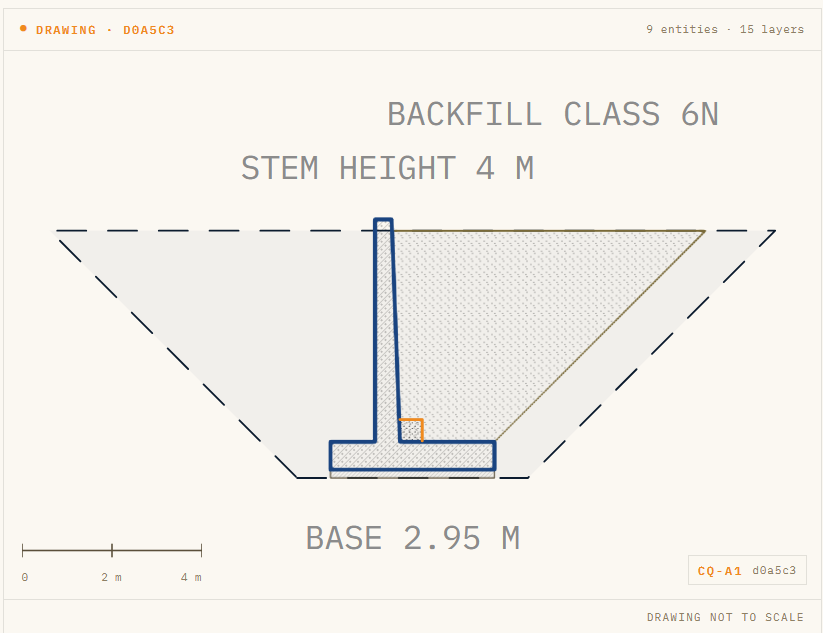
The default cantilever wall as the engine draws it: the battered open dig, the stem and base, and the perforated land drain at the heel. The hash cell (d0a5c3) ties this drawing to the bill below.
Step 1, identify the classes. The excavation, disposal and backfill sit in Class E. The blinding and reinforced concrete sit in Class F. The reinforcement and formwork sit in Class G. The wall's perforated land drain sits in Class I, with its granular surround in Class L. One structure, five work classes.
Step 2, list and measure the items. Working through the wall and applying each class's rules gives the principal rows below.
| CESMM code | Description | Quantity | Unit |
|---|---|---|---|
| E.4.2.5 | General excavation, maximum depth 2 to 5 m | 956.75 | m³ |
| E.5.3 | Disposal of excavated material off-site | 434.19 | m³ |
| E.6.3.2 | Filling, imported selected granular material, Class 6N to SHW | 344.75 | m³ |
| E.6.2.1 | Filling, excavated material | 522.56 | m³ |
| F.1.1.1 | In-situ concrete blinding, C8/10, 150 mm | 11.06 | m³ |
| F.6.2.3 | In-situ reinforced concrete C32/40, stem and base | 74.38 | m³ |
| G.5.1.4 / G.5.1.5 / G.5.2.5 | Reinforcement, B500B high-yield bar (12 mm and 16 mm, straight and bent) | 9.67 | t |
| G.1.4 | Formwork to vertical and battered faces | 225.07 | m² |
| I.4.4.2 | Perforated land drain, HDPE, 150 mm bore | 25 | m |
| L.5.2 | Granular surround to drain, 20 mm single-size aggregate | 4.00 | m³ |
| E.7.2 | Geotextile separator, 200 g/m², including laps | 22.00 | m² |
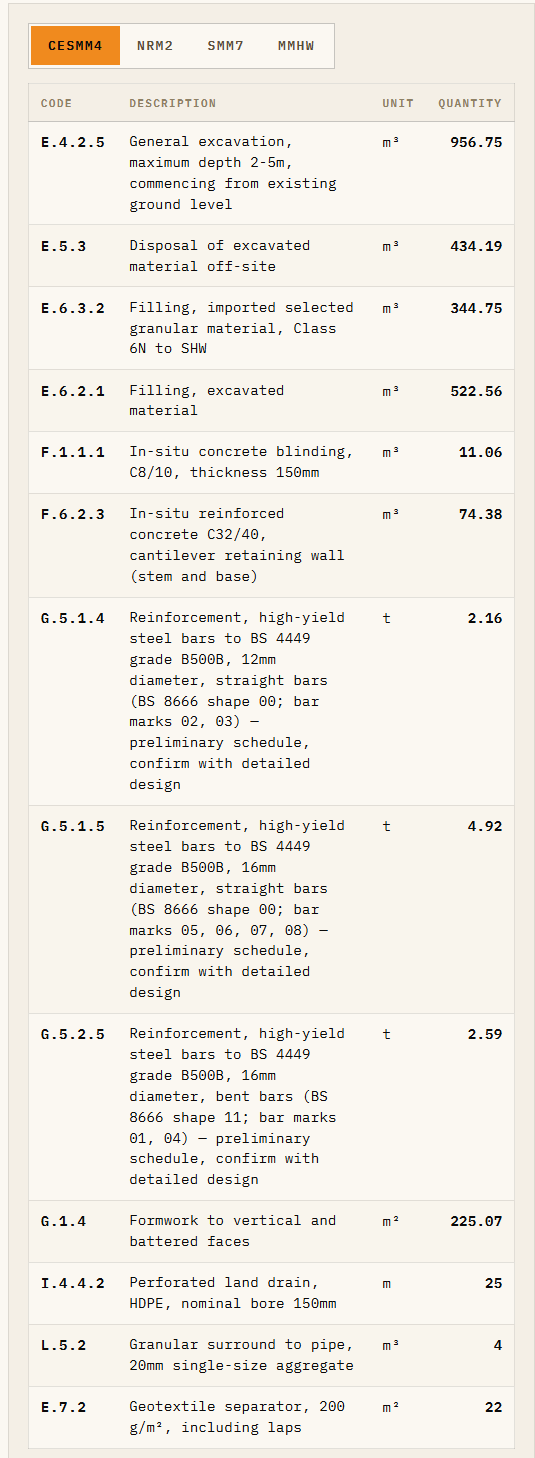
The same bill in CivilQuants, here on the CESMM4 tab. The switcher at the top re-codes the identical quantities to NRM2, SMM7 or MMHW: same wall, four rulebooks.
Step 3, show the derivation on the rows that matter. Two are worth seeing:
- Reinforced concrete, 74.38 m³. This is the stem and base together for the full 25 m run. The CivilQuants engine separates the bar schedule beneath it into three rows (12 mm straight, 16 mm straight, 16 mm bent), totalling 9.67 t at the assumed 130 kg/m³ intensity, so the rebar tonnage on the bill is traceable to a preliminary schedule rather than a round guess. The note on those rows says "confirm with detailed design", because a take-off intensity is not a bar bender's schedule.
- General excavation, 956.75 m³. This is the open dig for stem, base and working space, with a 0.6 m working space and a 1:1 batter, measured to the depth band 2 m to 5 m. Tighten or widen the working space and both this quantity and the disposal quantity move. That sensitivity is the single most common reason two estimators bill different earthworks quantities for the same wall.
Step 4, state the assumptions. Here is the CESMM "show your working" discipline in action. The earthworks quantities depend on the retained fill height, which this wall measures to 3.80 m, a 0.20 m freeboard below the 4.0 m stem. That assumption is the single biggest driver of the excavation and backfill numbers, so a good bill makes it explicit rather than burying it. Change the retained height and both the excavation and the backfill move with it.
That is exactly the behaviour a good BoQ needs. The quantity that depends on the assumption is measured, the assumption is stated, and the reader can override it. A commercial manager querying the earthworks quantity sees the 0.20 m freeboard immediately, instead of arguing about a number with no working behind it.
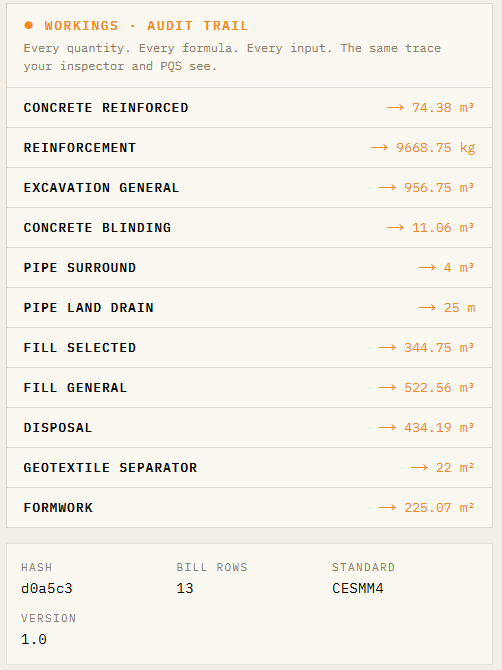
The audit trail behind the bill: every category total traced to its derivation, stamped with the hash cell (d0a5c3), the bill-row count and the standard. This is the trace a checker or PQS sees, and it is what makes a quantity defensible.
For the same wall measured against a gravity wall, and the drainage-specific detail, see how retaining walls are measured.
Common CESMM4 mistakes
- Standards drift. Half the items measured to CESMM4 and half to a remembered version of an older method. Pick one edition and hold it across the bill.
- Unstated assumptions. Quantities that depend on working space, batter or retained height, with none of it written down. The number is unarguable only when the assumption is visible.
- Missing method-related charges. Folding dewatering or temporary propping into measured rates instead of billing them separately. It hides cost and breaks comparability.
- Mixing classes. Putting formwork or reinforcement in Class F with the concrete instead of Class G. The class sets the rate basis, so the wrong class quietly misprices the item.
Doing it faster
Measuring a wall by hand to CESMM4 is an afternoon's work and an afternoon's chance to drop a row or mis-band the excavation depth. A parametric approach inverts it: you enter the geometry, the engine measures every item to the chosen standard and shows the derivation for each row. CivilQuants does exactly that for 46 civil assemblies, with the audit trail attached, so the bill above took seconds and is reproducible by anyone with the same inputs. Output is measured in accordance with CESMM4; it is a tool for the estimator, not a replacement for one.
Try it
Generate a CESMM4 bill from geometry yourself. Start a 7-day pass for £15, or try a free assembly to MMHW with no sign-up, then build the same wall on the cantilever wall calculator.
Frequently asked questions
- What does CESMM4 stand for?
- The fourth edition of the Civil Engineering Standard Method of Measurement, published by the Institution of Civil Engineers through Thomas Telford.
- How many work classes are in CESMM4?
- 26, lettered A to Z. Each class sets the measurement rules and units for a category of civil work.
- Is CESMM4 still the current edition?
- Yes. CESMM4 is the current edition in general use for UK civil engineering measurement.
- What is a method-related charge in CESMM?
- A cost tied to how the contractor does the work rather than to the measured quantity, for example mobilising plant or dewatering. CESMM keeps these separate from measured work.
- How is a retaining wall measured under CESMM4?
- As a composite. The excavation, disposal and backfill fall in Class E, the in-situ concrete in Class F, the reinforcement and formwork in Class G, and the wall drainage across Classes I and L.
- Can I prepare a CESMM4 BoQ in Excel?
- Yes, and most estimators do. The cost is rebuilding the same take-off each time and re-checking every formula. A parametric engine removes the rebuild and shows the derivation, which Excel does not.
- What is the difference between CESMM4 and NRM2?
- CESMM4 is a civil engineering method; NRM2 is a building method published by RICS. They classify and describe work differently.